
Table of Contents
- Why Art Defines a Modern Interior
- Top Art Styles for Modern Homes
- Modern Wall Art Ideas for Every Room
- Art Placement Rules for Interior Design
- How to Hang Art in a Modern Home
- Beyond the Canvas: Digital and Sustainable Options
- Conclusion: Building a Collection That Reflects You
- Frequently Asked Questions
Last Updated: September 7, 2026
Choosing the best art for modern home interior spaces is rarely about finding something that merely "matches the couch." It is about selecting pieces that anchor a room, introduce tension or calm, and reflect how you actually live.
AARTZY is an online gallery dedicated to showcasing and celebrating the diverse artistic talent of Sri Lanka to a global audience. We bridge the gap between creators and art lovers by offering a curated selection of original paintings, high-quality prints, and sculptures that tell unique stories of color and imagination. This guide breaks down the styles, placement rules, and hanging techniques that turn wall decor into a defining feature of your modern home interior.
The core insight is simple: art is not decoration, it is the architectural soul of a room. Below, we show you exactly how to choose, size, and hang pieces that create spatial balance and visual interest.
Why Art Defines a Modern Interior
Art is the finishing layer of interior design that gives a space character and emotional depth. A modern interior relies on clean lines and restrained furniture, which means the walls carry the responsibility for personality.
Visual stimuli directly influence mood, and the colors and forms you live with shape your daily experience. A bold abstract expressionism piece energizes a home office, while soft botanical art in a bedroom promotes relaxation.
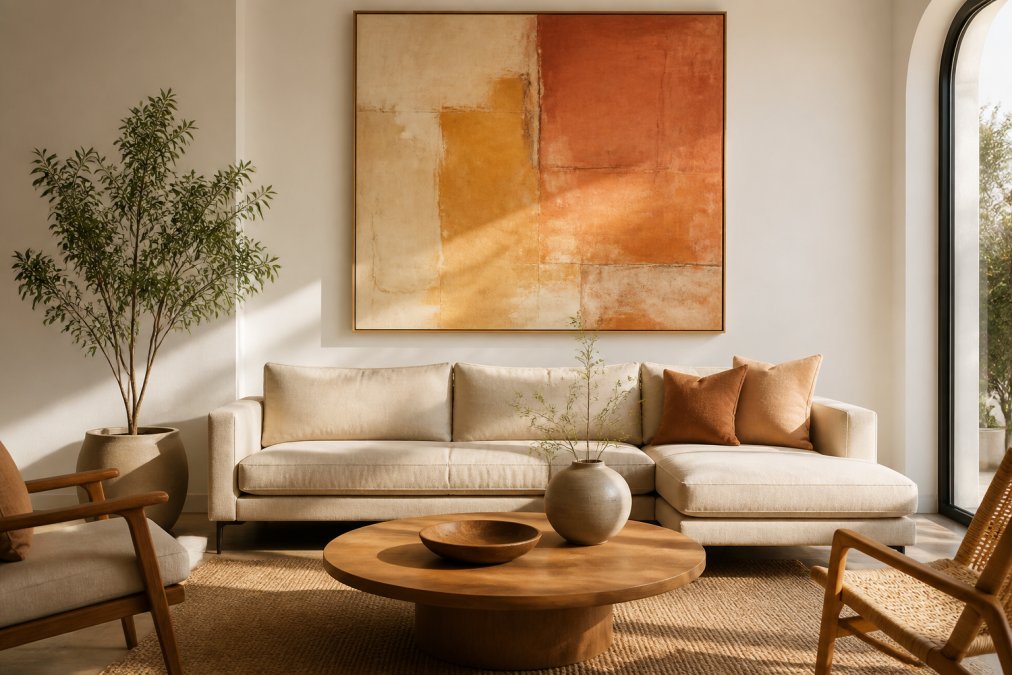
The most successful modern interiors treat art as the starting point, not the afterthought. Designers often select the artwork first, then build the room's color palette and furniture placement around it.
Top Art Styles for Modern Homes
Modern wall art ideas fall into distinct stylistic camps, each bringing a different energy to a space. The best art for modern home interior settings tends to favor bold abstraction, organic forms, or curated minimalism. But style alone is not enough, you also need to understand the material quality and production method behind each piece.
Abstract Expressionism and Surrealism
Abstract expressionism remains the dominant choice for contemporary style interiors because it introduces movement and emotion without literal imagery. Large canvas prints with gestural strokes or color field compositions create a focal point that draws the eye across the room.
When evaluating abstract or surrealist pieces, the production method matters as much as the composition.
Landscape and Nature-Inspired Art
Landscape and nature-inspired art offers a counterpoint to the urban sleekness of many modern homes. Landscape photography of dramatic coastlines or misty forests brings organic texture and a sense of calm to minimalist aesthetic spaces. These pieces work especially well in homes that favor warm minimalism and natural materials like wood and stone.
For landscape photography, the print medium dramatically changes the piece's character. A matte fine-art paper print emphasizes subtle tonal gradations and suits serene, contemplative scenes. A metallic or glossy print intensifies color saturation and contrast, making it ideal for dramatic coastal or desert imagery. For textile art, check the fiber content, natural fibers like wool, linen, and cotton age gracefully and develop character, while synthetic blends can pill, fade, or warp within a few years. Handwoven pieces from artisan cooperatives also carry a provenance that machine-made decor cannot replicate.
Identifying Quality Prints vs. Originals
Original works, by contrast, carry inherent uniqueness. Even a modest original painting by an emerging artist holds more intrinsic value than a mass-produced print of a famous work. Original pieces also offer texture, the physical presence of brushstrokes, palette knife marks, or layered mediums, that no reproduction can capture. This tactile quality matters in modern interiors, where the interplay of light across a textured surface adds depth that flat prints cannot achieve.
Modern Wall Art Ideas for Every Room
Each room in your home demands a different approach to art selection. The living room benefits from bold, large-scale pieces that anchor social gatherings. Hallways and entryways are ideal for curated collections that tell a story as guests move through your space.
Creating a Curated Gallery Wall
A gallery wall is one of the most versatile modern wall art ideas for filling large expanses without committing to a single oversized piece. The key is intentional curation, not random accumulation. Start with a unifying element, whether that is a consistent framing style, a shared color palette, or a thematic thread like abstract expressionism or botanical art.
Choosing Art Based on Room Function
Room function should drive your art choices more than any trend. High-traffic living areas benefit from durable canvas prints and pieces with strong visual impact. Home offices need art that motivates without distracting, often favoring landscape photography or geometric abstraction.
Art Placement Rules for Interior Design
Art placement rules for interior design center on one principle: the artwork should relate to the furniture beneath it and the space around it. The most common mistake is hanging art too high, which breaks the visual connection between the piece and the room's seating arrangement.
Mastering Proportion and Scale
Proportion and scale determine whether a piece feels intentional or accidental. A common rule of thumb is that art should span roughly two-thirds to three-quarters of the width of the furniture below it. For empty walls, larger is almost always better, as a single substantial piece creates more impact than several small ones scattered across the surface.
Coordinating Your Color Palette
Your art should either complement or intentionally contrast with your room's color palette. Complementary art picks up accent tones from your furniture and textiles, creating a cohesive, pulled-together look. Contrasting art introduces a bold accent wall effect by bringing in colors absent from the rest of the room.
How to Hang Art in a Modern Home
How to hang art in a modern home comes down to three variables: height, hardware, and alignment. The center of the artwork should sit at eye level, typically 57 to 60 inches from the floor, which is the standard used by most galleries and museums (si.edu).
Framing Styles and Mounting Hardware
Framing styles should complement both the artwork and your interior design approach. Thin metal frames suit contemporary style and abstract pieces, while natural wood frames warm up landscape photography and botanical art. For canvas prints, frameless gallery wrapping offers a clean, modern look that works in minimalist aesthetic spaces.
Beyond the Canvas: Digital and Sustainable Options
The best art for modern home interior spaces is no longer limited to traditional paintings and prints. Digital art and smart displays allow you to rotate through a curated collection of works at the touch of a button, making them ideal for those who like to refresh their spaces seasonally.
Digital Art and Smart Displays: The Technical Side
Digital frames have matured significantly in recent years. The current generation of smart displays offers 4K resolution, which translates to roughly 8.3 million pixels, enough to render fine art detail convincingly. However, resolution is only part of the equation. Color accuracy matters more. Look for displays that cover at least 90% of the DCI-P3 color space, the standard used in digital cinema and professional photo editing.
Anti-glare matte screens are essential for bright living spaces. Glossy displays create reflections that compete with the artwork itself, especially during daylight hours. Many high-end digital frames also include ambient light sensors that automatically adjust brightness to match the room's lighting conditions.
When curating digital art, resolution standards matter. A piece displayed at 4K needs a source file of at least 3840 x 2160 pixels. Upscaling a lower-resolution image introduces artifacts and softness that become obvious on a large display. Reputable digital art platforms specify the native resolution of each work, and many now offer files optimized specifically for popular frame sizes.
Sustainable and Eco-Friendly Art: Verification and Sourcing
Sustainable and eco-friendly art is another growing priority for conscious collectors. Many artists now work with reclaimed materials, natural pigments, and responsibly sourced wood for framing. Choosing sustainable pieces supports environmental stewardship while adding unique texture and depth that mass-produced decor cannot replicate. For collectors who value both ethics and aesthetics, sustainable art practices are increasingly documented by environmental design organizations, this represents a meaningful way to align your home with your values.
But "eco-friendly" claims vary widely in substance. A practical verification approach involves asking three questions. First, what is the substrate? Canvas made from recycled polyester or organic cotton, and paper sourced from Forest Stewardship Council (FSC)-certified mills, are verifiable claims. Second, what are the pigments and inks? Water-based inks and natural pigments have a lower environmental footprint than solvent-based alternatives.
Supporting local artists is another dimension of sustainability. Shipping art across the country or internationally carries a significant carbon footprint, especially for oversized pieces that require custom crating. Commissioning or purchasing from artists within your region reduces transportation emissions and keeps money in your local creative economy.
Conclusion: Building a Collection That Reflects You
Selecting the best art for modern home interior spaces is a personal journey that rewards patience and intentionality. Start with pieces that genuinely move you, then apply the placement and scale principles outlined here to ensure they shine in your space.
For those seeking artwork with authentic cultural narratives and original craftsmanship, AARTZY offers a curated selection of paintings, prints, and sculptures from Sri Lankan artists. Each piece is sourced from experienced and emerging creators, with free worldwide shipping and secure payment processing. Whether you are a first-time collector or a seasoned enthusiast, understanding art valuation and provenance adds confidence to every purchase and ensures your investments hold meaning for years to come.
Explore the AARTZY collection and find a piece that transforms your modern home interior into a reflection of your unique perspective.
Frequently Asked Questions
What is the 3-5-7 rule in interior design?
The 3-5-7 rule is a styling guideline for creating visually balanced vignettes and displays. In practice, it suggests grouping decorative objects in odd numbers, such as three, five, or seven items, as this tends to look more natural and interesting to the eye than even-numbered groupings. For art specifically, you can apply this rule when arranging a gallery wall or styling a shelf with small framed pieces and sculptures.
What kind of wall art is trending right now?
In 2026, trends lean toward warm minimalism, organic textures, and bold abstract expressionism. Large-scale canvas prints with earthy tones and landscape photography that brings nature indoors are also popular.
What is the 70/30 rule in art?
The 70/30 rule is a design principle suggesting that 70% of a room's visual weight should come from a dominant element, while the remaining 30% comes from supporting accents. Applied to wall art, this could mean one large, commanding statement piece takes up about 70% of the visual space on a wall, while smaller complementary pieces or decor fill the remaining 30%.
What is the 2/3 rule for wall art?
The 2/3 rule is a key art placement guideline for proportion and scale. It states that a piece of art should be about two-thirds the width of the furniture it hangs above, such as a sofa or bed. This ensures the art feels anchored to the furniture and creates a balanced focal point. Following this rule prevents a piece from looking lost on a large wall or overwhelming the furniture beneath it.