
Table of Contents
- Why Hand-Painted Sri Lankan Canvas Belongs in Your Collection
- Are Original Sri Lankan Paintings Worth the Price?
- How to Identify Authentic Sri Lankan Art
- Shipping Original Canvas Art Internationally
- Featured Hand-Painted Sri Lankan Canvas Pieces
- Caring for Your Hand-Painted Canvas
- Frequently Asked Questions
Last Updated: September 27, 2026
Why Hand-Painted Sri Lankan Canvas Belongs in Your Collection
A hand-painted Sri Lankan canvas is an original work by a Sri Lankan artist using traditional techniques, natural materials, and culturally rooted imagery that reflects the island's artistic heritage. This AARTZY guide covers what you need before buying, from authentication to international shipping.
Are Original Sri Lankan Paintings Worth the Price?
For collectors who value cultural heritage and one-of-a-kind craftsmanship, original Sri Lankan paintings justify their cost through provenance, technique, and long-term appreciation. The question is whether the value matches what you receive.
What Drives the Cost of Original Canvas Art
Several factors determine the price of an original canvas painting:
- Artist reputation and exhibition history, Established artists with gallery representation command higher prices than emerging talents
- Size and material quality, Larger canvases require more materials and time; professional-grade acrylics and stretched linen cost more than student-grade supplies
- Complexity of technique, Impasto work, detailed cultural motifs, and multi-layered compositions take significantly longer to complete
- Cultural significance, Pieces depicting important religious or historical subjects often carry premium pricing
- Provenance documentation, Works with clear ownership history and artist-signed certificates add value
Comparing Value: Originals vs. Prints vs. Mass-Produced Decor
| Factor | Original Canvas | Limited Print | Mass-Produced Decor |
|---|---|---|---|
| Uniqueness | One of one | Numbered edition | Thousands identical |
| Material quality | Artist-grade canvas | Archival paper | Synthetic materials |
| Cultural authenticity | Direct from artist | Reproduction | Generic design |
| Investment potential | Appreciates over time | Stable value | Depreciates |
| Personal connection | Direct artist story | Indirect | None |
Comparing original art prices to print prices is a common mistake: prints offer accessibility, while originals offer permanence and a direct connection to the artist's hand.
How to Identify Authentic Sri Lankan Art
Authentication rests on three independent pillars: documented provenance, verifiable artist credentials, and physical evidence on the canvas itself. A piece satisfying only one or two is a candidate for scrutiny, not a confirmed original.
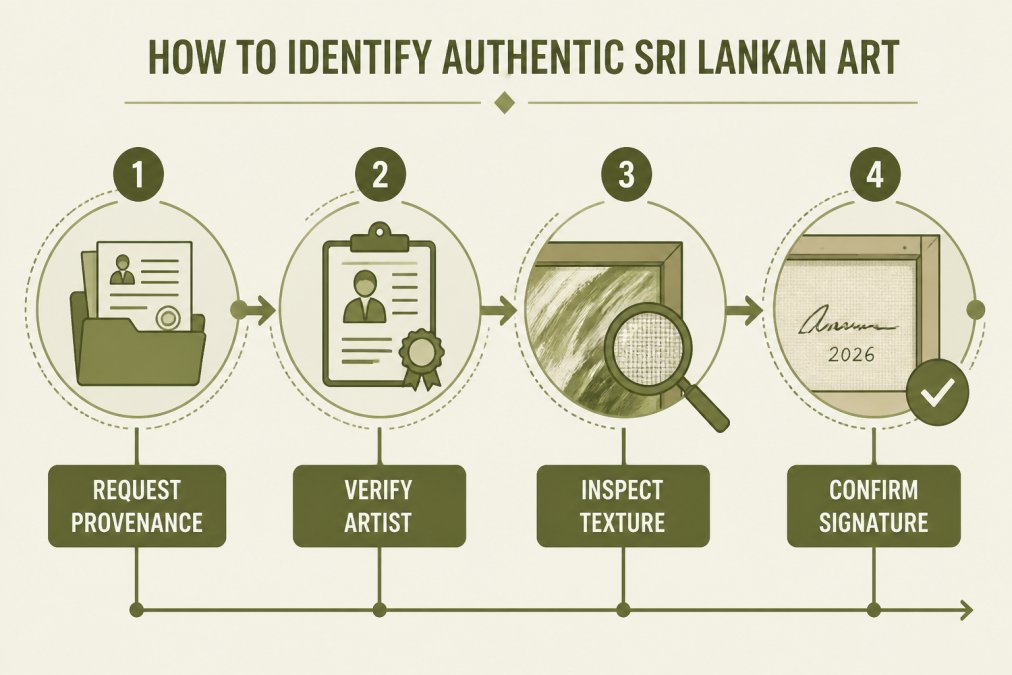
Verifying the Artist Through Recognized Institutions
Sri Lanka's formal art infrastructure gives buyers real verification paths:
- The George Keyt Foundation maintains records and exhibitions tied to one of the island's most documented modern masters; works attributed to Keyt or his circle should be cross-checked against foundation and auction-house records.
- The University of the Visual and Performing Arts (UVPA) in Colombo and the Institute of Aesthetic Studies produce many of the artists whose works circulate internationally. Alumni records and department exhibitions are legitimate credential sources.
- The Sri Lanka Art Council and provincial cultural councils register exhibitions and, in some cases, artists. A gallery claiming an artist is "council-registered" should be able to produce the registration reference.
- Auction records from houses handling South Asian modern and contemporary art are the most reliable public price and provenance signal. No auction record is not disqualifying, but provenance must then come entirely from the gallery and artist.
When buying online, ask these questions:
- Does the gallery provide a signed certificate of authenticity listing title, medium, dimensions, and date?
- Can the gallery name the artist's training institution, teachers, or exhibition history?
- Is there a documented exhibition history for the piece or the artist?
- Does the gallery have a verifiable business history and physical address?
Physical Inspection: What a Hand-Painted Canvas Actually Shows
Photographs hide what matters. Request the following before purchase, and treat refusal as a signal:
- Raking-light close-ups. Light angled across the surface reveals impasto ridges, brush drag, and canvas weave. A giclée print looks flat under raking light even when it photographs convincingly head-on.
- Edge and wrap shots. Hand-painted canvases frequently show paint carried over the stretcher edge from the artist's working process. Prints on canvas usually stop at a clean, uniform border.
- Signature macro. Hand-signed works show pressure variation, slight ink or paint pooling, and irregular stroke width. Printed signatures are pixel-perfect and identical across editions.
- Verso (back) photograph. Look for the artist's hand, gallery labels, exhibition stickers, or framing stamps. A back that is completely blank on a supposedly decades-old piece is worth questioning.
- UV or blacklight image if available.
Red Flags Specific to This Market
- Prices that are dramatically below comparable original works from the same artist or region.
- A certificate of authenticity that is a photocopy, lacks a signature, or omits dimensions.
- Listings that use the same photograph across multiple "one-of-a-kind" pieces.
- Sellers who cannot name the artist's city, training, or any prior exhibition.
- Pressure to complete payment outside the platform's normal checkout, which removes any buyer protection.
Running all three pillars, institution, documentation, and physical evidence, catches the overwhelming majority of misrepresented pieces before money changes hands.
Shipping Original Canvas Art Internationally
Most damage and customs surprises are preventable with the right packing standard, tariff classification, and insurance paperwork.
Packing Standards That Prevent Damage
Professional art shipping follows specific protocols:
- Glassine paper placed directly against the painted surface prevents smudging and moisture damage
- Foam board or rigid backing supports the canvas and prevents flexing
- Custom crating for stretched canvases provides rigid outer protection
- Moisture barriers protect against humidity changes during transit
- Corner protectors absorb impact at the most vulnerable points
Roll unstretched canvases paint-side outward around a rigid core, wrap in glassine and a moisture barrier, and ship in a rigid tube. Stretched canvases need a custom crate with foam standoffs. AARTZY ships every piece securely in a crate with tracking and free worldwide shipping, removing a common friction point for international buyers.
Customs Classification: The HTSUS Code That Applies
Original paintings entering the United States are classified under the Harmonized Tariff Schedule of the United States (HTSUS), maintained by the U.S. International Trade Commission. The heading for original paintings, drawings, and pastels executed entirely by hand is HTSUS 9701, with subheadings distinguishing originals from reproductions and antiques. A genuine hand-painted original falls under a different subheading than a giclée, and duty treatment differs accordingly.
Two practical consequences follow:
- The commercial invoice must describe the work accurately. "Painting, original, hand-executed, by [artist name]" is the language customs expects. Vague descriptions like "artwork" or "decor" invite delays and reclassification.
- Reproductions are not originals for tariff purposes. If a seller ships a print under an original-painting classification, the buyer can face a customs adjustment, and the shipment may be held.
De Minimis, Duties, and What You Actually Owe
The United States maintains a de minimis threshold under which most shipments enter free of duty with reduced paperwork. As of the most recent statutory adjustment, that threshold is $800 per shipment per day per importer. Below it, most single-canvas purchases clear without duty; above it, the shipment requires an entry and duty applies at the applicable HTSUS rate.
What this means in practice:
- Multiple canvases in one shipment, or a single high-value piece, will likely exceed the threshold and require an entry.
- The carrier (not the buyer) usually files the entry and bills duty plus a brokerage fee, which is often the larger of the two charges.
- State sales tax may still apply depending on the buyer's state and how the marketplace handles tax collection.
Insurance and Claims: What to Arrange Before the Piece Ships
Insurance is non-negotiable for original art shipments. Reputable galleries insure for full purchase value and provide tracking documentation. If a piece arrives damaged, the claims process depends on who arranged insurance.
A common pattern that protects buyers:
- The gallery insures the shipment for full declared value and names the buyer as the beneficiary.
- The gallery photographs the piece immediately before packing, with a visible date reference.
- The buyer photographs the unopened crate and then the opened crate before removing the canvas.
- Any damage is reported to the carrier within the carrier's stated window (often 24-72 hours for visible damage).
Carrier Choice and Transit Realities
International art shipments move via express courier (fastest, most transparent brokerage), air freight (best for crated, high-value pieces), or consolidated freight (slowest, cheapest, highest handling risk). For a single stretched canvas, express courier with a custom crate is the most predictable option.
Featured Hand-Painted Sri Lankan Canvas Pieces
These original, hand-painted canvases from AARTZY's collection show the range of techniques, subjects, and cultural narratives available to collectors.
Caring for Your Hand-Painted Canvas
Proper care preserves the visual quality and long-term value of hand-painted canvas art. Originals on canvas are more resilient than works on paper but still need attention to environmental conditions.
- Avoid direct sunlight, UV exposure fades pigments over time; hang away from windows or use UV-filtering glass if framing
- Maintain stable humidity, Extreme fluctuations cause canvas to expand and contract, leading to cracking
- Dust gently, Use a soft, dry brush or microfiber cloth; never use liquid cleaners on painted surfaces
- Handle by the frame, Oils from hands can damage canvas edges; always lift by the frame or backing
- Professional cleaning only, For significant buildup or damage, consult an art conservator rather than attempting repairs
Frequently Asked Questions
How can I verify the authenticity of hand-painted Sri Lankan canvas art?
Request provenance documentation that traces the piece from the artist's studio to the seller. Look for a signed certificate of authenticity, artist biography, and high-resolution images showing brush texture and canvas weave. On a genuine hand-painted Sri Lankan canvas, you will see variations in paint thickness, visible brushstrokes, and slight irregularities that digital reproductions lack. Reputable galleries provide detailed provenance and stand behind their attributions.
Are original Sri Lankan paintings worth the price compared to prints?
Original hand-painted canvases are one-of-a-kind and typically appreciate or hold value better than mass-produced prints. A $1,109.99 original like Sigiriya's Sunlit Path offers textured impasto work and a direct connection to the artist's hand. Prints can be beautiful, but they lack the investment potential and tactile quality of an original. If you want a lasting piece with cultural and financial value, an original is worth the premium.
What should I look for when buying original canvas paintings online?
Check for clear, high-resolution photos that show surface texture and edges. Read the artist's statement and exhibition history. Confirm the seller offers secure payment, tracking, and a damage policy. Ask about the canvas material, paint type, and whether the piece arrives stretched or rolled. A gallery that provides these details, like AARTZY, reduces the risk of buying a misrepresented or damaged work.
How is original canvas art shipped internationally without damage?
Professional sellers ship stretched canvases in custom crates with foam padding and moisture barriers. Rolled canvases travel in rigid tubes. Reputable galleries include tracking and insurance. For example, AARTZY ships in secure crates with tracking available and offers worldwide shipping. Always confirm the seller's packing method and damage resolution policy before purchase, especially for high-value pieces.