
Table of Contents
- One-of-a-Kind vs. Reproductions: The Core Difference
- The Role of Labor and Time in Original Art Costs
- Material Costs and Overhead: Why Originals Cost More to Make
- How to Value Original Artwork: A Practical Framework
- Limited Edition vs Open Edition Prints: What the Numbers Mean
- Art Investment for Beginners: Does Original Art Hold Its Value?
- Texture, Dimension, and the Emotional Pull of Originals
- Conclusion
- Frequently Asked Questions
Last Updated: September 26, 2026
One-of-a-Kind vs. Reproductions: The Core Difference
An original artwork is a singular piece made by the artist's own hand, while a print is a reproduction of an existing image. That distinction drives nearly every pricing gap between the two.
When you buy an original, you own the only version that will ever exist. The artist mixed the paint, built the layers, and made every decision on that surface. A print, by contrast, is one of many copies produced from a digital scan or a printing plate. Many buyers assume the price gap comes down to materials. It doesn't. It comes down to scarcity, labor, and the fact that no second original can ever be made.
At AARTZY, we see this play out constantly with collectors weighing a one-of-a-kind painting against a lower-cost reproduction. The sticker shock is real, but so is the difference in what you actually own.
The Role of Labor and Time in Original Art Costs
Labor is the largest single driver of why original art costs more than prints, because a painting consumes dozens of hours that a print never touches.
Consider the gap in working time. An artist may spend weeks on a single canvas, layering color, correcting mistakes, and reworking sections that don't hold together. A limited edition print might take an hour of setup and proofing. An open edition print takes minutes once the file is prepared.
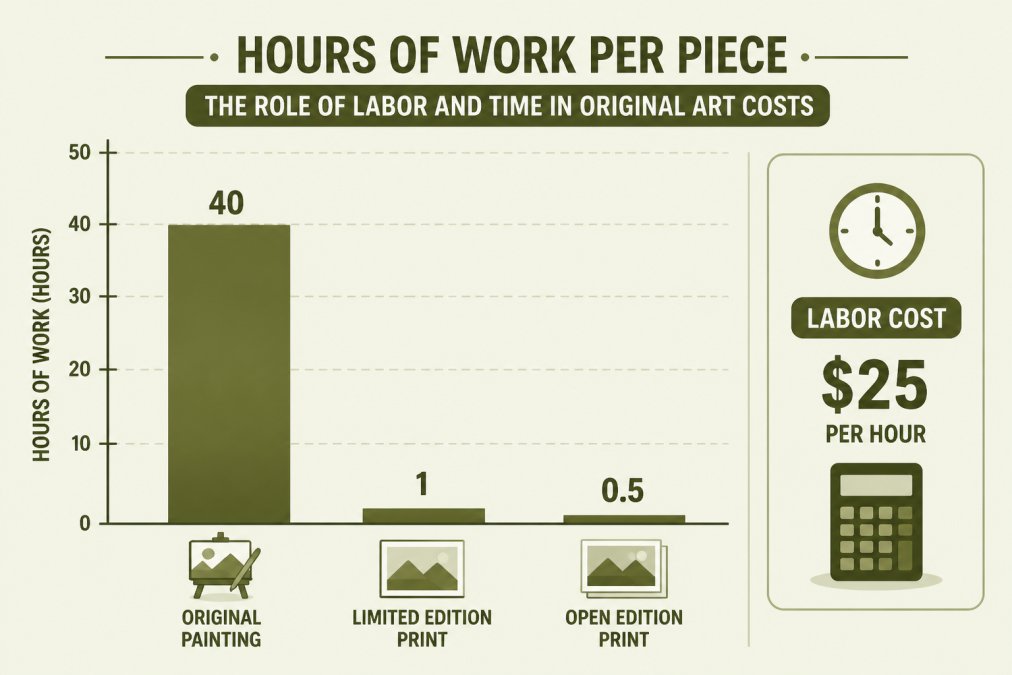
That time has a cost. If an artist values their hours at even a modest rate, a 40-hour painting carries labor that a print simply does not. Most guides skip this point. The price of an original isn't just the paint on the canvas, it's the weeks of the artist's life embedded in it.
A common mistake among new buyers is comparing an original to a print as if they were the same product at different quality levels. They aren't. You're comparing a handmade object to a manufactured copy.
Material Costs and Overhead: Why Originals Cost More to Make
Materials for an original cost far more than most people expect, and overhead adds another layer that prints avoid almost entirely.
A serious painter works in archival materials: stretched canvas or heavy paper, professional-grade pigments, primers, and varnish. These supplies are not cheap, and mistakes waste them. A failed passage gets sanded, repainted, or abandoned entirely. Prints, by contrast, use ink and paper, and the digital file can be reprinted indefinitely without loss.
Overhead matters too. Studio rent, lighting, storage, framing, and shipping all fall on the artist. A large canvas needs a proper frame and careful crating to arrive undamaged. That cost is baked into the price of the original. A print ships flat in a tube for a fraction of the expense.
The U.S. Copyright Office guidance on visual arts also plays a role here. Copyright protection applies to the original creative work, which affects how reproductions may be made and sold, adding legal weight to the value of the source piece.
How to Value Original Artwork: A Practical Framework
Valuing original artwork means weighing five factors together, not judging on any single one. Use this framework when you're deciding whether a price is fair.
| Factor | What to Check | Why It Matters |
|---|---|---|
| Provenance | Artist history, exhibition record, ownership chain | Confirms authenticity and supports resale value |
| Labor | Hours invested, complexity of technique | Explains the base cost of a handmade piece |
| Materials | Archival pigments, canvas, framing quality | Determines how well the piece survives over time |
| Scarcity | One-of-a-kind or limited run | Drives long-term appreciation potential |
| Emotional pull | Personal connection to the work | Justifies the purchase beyond pure numbers |
Start with provenance. Ask where the piece came from, who has owned it, and whether documentation exists. Then look at labor and materials, which set the floor for a fair price. Scarcity and emotional pull sit on top of that foundation.
Limited Edition vs Open Edition Prints: What the Numbers Mean
A limited edition print is capped at a fixed number of copies, while an open edition print can be reproduced without limit. That cap is the entire reason limited editions cost more, but the size of the cap, the printing method, and the paper all move the price further.
When an artist releases a limited edition, they commit to producing a set number of prints, commonly 25, 50, 150, or 250, and then stop. Each copy is numbered (for example, "12/150") and often signed. The scarcity is built in. Once the run sells out, no more exist at that size or format. An open edition has no such ceiling. The publisher can print more whenever demand appears, which keeps the price low and the resale value flat.
The giclée distinction. Most limited editions sold today are giclée prints, fine-art reproductions made on an inkjet printer using pigment-based inks rather than dye-based inks. Pigment inks are rated for far longer display life than dye inks, and when paired with cotton rag or alpha-cellulose paper that meets archival standards, a giclée can hold its color for decades under normal indoor conditions. That archival combination is a large part of why a limited-edition giclée costs more than a poster-style open edition printed on thin coated stock. The paper alone can cost several times more per sheet.
Why edition size drives price. A run of 25 spreads the artist's setup, proofing, and signing time across far fewer buyers than a run of 250. Smaller editions also tend to appreciate more on the secondary market because fewer copies circulate. A common pattern is that a signed and numbered print from a sold-out edition of 50 resells for more than the same image in an open edition, sometimes several times more, while an open edition of the same image rarely gains value at all.
Where limited editions sit on the ladder. This is the nuance that trips people up. A limited edition print is still a reproduction, not an original. It carries more value than an open edition, but it will never match a one-of-a-kind painting, because the original remains the single source image and the only handmade object. Think of it as a bridge: an open edition is the entry point, a limited-edition giclée is the middle rung, and the original sits at the top.
Art Investment for Beginners: Does Original Art Hold Its Value?
Original art can hold or grow in value, but only when the artist's reputation, the work's provenance, and market demand all move in your favor. It is not a guaranteed investment, and treating it like one is the fastest way to lose money.
Texture, Dimension, and the Emotional Pull of Originals
Texture is something a print cannot replicate, and it's often the reason collectors say an original "feels alive" in a way a reproduction never does.
Conclusion
The gap between an original and a print comes down to time, materials, scarcity, and the simple fact that a handmade object can't be duplicated. Understanding that gap is what separates a confident collector from someone who overpays for a copy.
Frequently Asked Questions
What is the difference in price between a print and an original painting?
Original paintings typically cost 5 to 20 times more than prints. For example, an original watercolor like 'Floating Pink Water Lilies' is priced at $869.99, while a giclée print of similar size might sell for $50 to $150. The gap reflects labor, materials, and the fact that an original is a one-of-a-kind physical object. Limited edition prints sit in between, often $200 to $500, because they are produced in small runs and signed by the artist. Open edition prints are the most affordable but hold little investment value.
Does original art hold its value better than prints?
Original art generally holds value better because it is a tangible asset with inherent scarcity. Prints, especially open editions, can be reproduced indefinitely, which limits appreciation. Limited edition prints may gain value if the artist becomes more sought after, but they rarely match the resale performance of originals. For beginners, buying original art from emerging artists can be a more stable long-term investment, provided you research the artist's trajectory and market demand.
Are limited edition prints worth the investment compared to originals?
Limited edition prints can be worth it if the edition size is small (typically under 150) and the artist is well-regarded. They offer a lower entry point, often $200 to $500, and are easier to store. However, they are still reproductions. Originals, like 'Bridge Over Calm Waters' at $1,159.99, carry the artist's direct hand, provenance, and physical texture. For pure investment, originals have stronger potential; for decoration on a budget, limited editions are a reasonable compromise.
How does the labor-intensive process of painting affect pricing?
A single original painting can take 20 to 100 hours of focused work. At a modest $25 per hour, that is $500 to $2,500 in labor alone, before materials. Artists also spend years developing skills, and many hold other jobs while building a portfolio. Prints, by contrast, are scanned and reproduced in minutes. The labor gap is the largest single reason original art costs more. When you buy an original, you are paying for the artist's time, expertise, and the fact that no one else can own that exact piece.