
Last Updated: October 29, 2026
Quick Summary
Daha ata sanniya masks are a set of eighteen carved and painted demon masks used in a traditional Sinhalese healing ritual in Sri Lanka. Each mask represents one specific malady attributed to a sanniya spirit. Authentic sets show eighteen individually designed faces rather than variations of one carving.
- A complete set contains eighteen masks, each representing one ailment attributed to a sanniya spirit.
- The masks are used in Sanni Yakuma, a traditional exorcism ceremony led by practitioners called kapuralas.
- Maha Kola Sanni is usually described as the leader of the group, with other sannis often presented as his retinue.
- A genuine set should have eighteen distinct, individually designed faces, not eighteen variations of one carving.
- Ask the seller which regional or workshop convention the set follows and who made the pieces.
Table of Contents
- What Daha Ata Sanniya Masks Are and What the Name Means
- Sanni Yakuma: The Healing Ritual Behind the Masks
- Why the Number Eighteen Matters in Sanniya Tradition
- The Eighteen Masks and the Ailments They Represent
- How a Sanni Yakuma Ceremony Unfolds, Step by Step
- How Sri Lankan Masks Are Made: Carving, Materials and Finishing
- Buying an Authentic Daha Ata Sanniya Mask Set
- Frequently Asked Questions
What Daha Ata Sanniya Masks Are and What the Name Means
Daha Ata Sanniya masks are a set of eighteen carved and painted demon masks used in a traditional Sinhalese healing ritual in Sri Lanka. The name translates loosely to "eighteen sanniya," with "sanniya" referring to the spirits or demons believed to cause illness. Each mask represents one specific malady attributed to these spirits.
The masks are sometimes called devil masks, a term that reflects how Western observers have described them. Within the tradition, however, the masks are tools of healing rather than objects of fear. A practitioner wears or displays them to identify and purge the afflictions the spirits are thought to cause.
Recognizing an authentic set starts with the basics. Each mask has its own distinct face, color scheme, and carved features. Counting the masks and checking that each one looks individually designed is a useful first step. Beyond the woodcarvings themselves, the broader context of traditional performance requires that one verify authentic cultural apparel to ensure the entire ensemble maintains its historical integrity.
Sanni Yakuma: The Healing Ritual Behind the Masks
Sanni Yakuma is the traditional exorcism ceremony in which the sanniya masks are used. The ritual is performed to diagnose and treat sickness by identifying which spirit is responsible and then driving it out through dance, chanting, and offerings.
Practitioners, sometimes called kapuralas, lead the ceremony. The masked dancers each embody a specific spirit, moving in sequences designed to represent the disease. The performance is not staged for spectators; it is a working healing event meant to restore the patient's health.
Understanding the ritual matters for anyone buying the masks. The objects were made to be used in performance, and the design of each face reflects its role in that process. When you see a mask, you are looking at one component of a larger practice that has lasted for generations.
Why the Number Eighteen Matters in Sanniya Tradition
The number eighteen is central to the tradition. The complete set of eighteen masks covers the range of ailments the ritual is meant to address, and the ceremony is structured around working through each one in turn.
The significance of eighteen is tied to the idea that the sanniya spirits cause a defined set of illnesses. Each mask answers one of these afflictions, so a full set represents the ritual's complete scope. Partial sets are sometimes used for specific purposes, but the complete grouping reflects the tradition in its fullest form.
Complete Daha Ata (18) Sanni Mask Wall Hanging - Vibrant Demon Series →
For buyers, this matters because a complete set is a coherent cultural object rather than a collection of unrelated faces. A set of eighteen shows the whole system the masks belong to.
The Eighteen Masks and the Ailments They Represent
Most pages on this topic mention that there are eighteen masks and then move on. If you want to see the Kapala and Gini Jala pieces for yourself, the Kapala Sanni and Gini Jala Sanni mask wall hanging is available to purchase. The list below does what those pages don't: it treats each mask as a single entry with its name, the sanniya spirit it embodies, and the ailment traditionally attributed to that spirit. Names vary between regions and between published accounts, so alternate spellings are noted where they are common.

| # | Mask (Sanni) | Spirit / Meaning | Traditional Ailment Association |
|---|---|---|---|
| 1 | Kola Sanni (Maha Kola) | The senior or "great" sanni | General illness and the presiding spirit of the set |
| 2 | Maru Sanni | Death spirit | Conditions historically linked to eyes and vision |
| 3 | Naga Sanni | Cobra spirit | Skin conditions and swellings |
| 4 | Kapala Sanni | Skull spirit | Madness and delirium |
| 5 | Gini Jala Sanni | Fire-flame spirit | Burning sensations and fever |
| 6 | Deva Sanni | Deity spirit | Epidemics and infectious disease |
| 7 | Vata Sanni | Wind spirit | Flatulence and disorders attributed to wind |
| 8 | Bihiri Sanni | Deafness spirit | Hearing loss and ear complaints |
| 9 | Kana Sanni | Blindness spirit | Eye disease and impaired sight |
| 10 | Kora Sanni | Lameness spirit | Lameness and joint or limb weakness |
| 11 | Pissu Sanni | Madness spirit | Mental disturbance and erratic behavior |
| 12 | Gulma Sanni | Tumor spirit | Abdominal growths and stomach complaints |
| 13 | Amukku Sanni | Hiccup or spasm spirit | Hiccups, spasms, and convulsive episodes |
| 14 | Golu Sanni | Dumbness spirit | Speech loss and throat complaints |
| 15 | Vevulum Sanni | Possession spirit | Tremors and possession-like fits |
| 16 | Kuru Sanni | Smallpox spirit | Pox and eruptive skin disease |
| 17 | Pita Sanni | Bile spirit | Bile disorders and digestive upset |
| 18 | Abutha Sanni | Strange or unnatural spirit | Unexplained ailments and sudden illness |
A few patterns are worth noticing. Several masks are named directly for the symptom they address, Bihiri for deafness, Kana for blindness, Kora for lameness, Golu for dumbness, which makes the set read almost like a traditional diagnostic chart. Others are named for the spirit's character rather than the illness, such as Kapala (skull) and Gini Jala (fire flame). Maha Kola Sanni is usually described as the leader of the group, and in performance the other sannis are often presented as his retinue.
For buyers, the practical takeaway is that a genuine set should show eighteen individually designed faces, not eighteen variations of one carving. Check that the named masks you can identify, Kola, Maru, Naga, Kapala, Gini Jala, are present and distinct, and ask the seller whether the set follows a particular regional or workshop convention. That question alone separates a documented set from a decorative assortment.
How a Sanni Yakuma Ceremony Unfolds, Step by Step
The sequence below describes the overall arc of a Sanni Yakuma ceremony as recorded in accounts of the tradition. Exact practice varies by region and by practitioner.
1. Consultation and diagnosis. The patient's family approaches a practitioner, often called a kapurala or adurā, who assesses the illness and identifies which sanniya is responsible.
2. Negotiation of the ritual. The practitioner and family agree on the scale of the ceremony, the offerings required, and the date. Larger ceremonies involve more dancers, drummers, and nights of performance, so this stage sets the practical scope.
3. Preparation of the arena. A space is cleared and decorated, an altar or offering station is set up, and the ritual objects, including the masks, are prepared. Offerings traditionally include food, flowers, and other items appropriate to the spirit being addressed.
4. Invocation and opening. Drumming and chanting open the ceremony and call the spirits. This stage establishes the ritual frame; without it, the later dances have no context.
5. Arrival of the sannis. The masked dancers appear in sequence, each embodying one sanniya. The performance typically builds from lesser spirits toward Maha Kola Sanni, who is often presented as the leader of the group. Each dance presents the spirit's character and the ailment it causes.
6. Dialogue and bargaining. In many accounts the practitioner or a ritual specialist addresses the spirit directly, questioning it, bargaining with it, and establishing what it wants. This is the dramatic core of the ceremony and the point at which the affliction is confronted.
7. Transfer and expulsion. The spirit is persuaded or compelled to leave the patient, often being transferred into an offering object or driven away. The masks are central here: the dancer embodying the spirit is the visible agent of its departure.
Complete Daha Ata (18) Sanni Mask Wall Hanging - Vibrant Demon Series →
8. Sending away and closing. The spirits are dismissed, the offerings are disposed of according to tradition, and the ceremony closes. The patient is then expected to recover.
A full Sanni Yakuma can run through the night and involve a large cast of dancers, drummers, and assistants. That scale is why the masks were treated as working ritual equipment rather than display pieces, and why complete sets were maintained and repaired over generations rather than replaced.
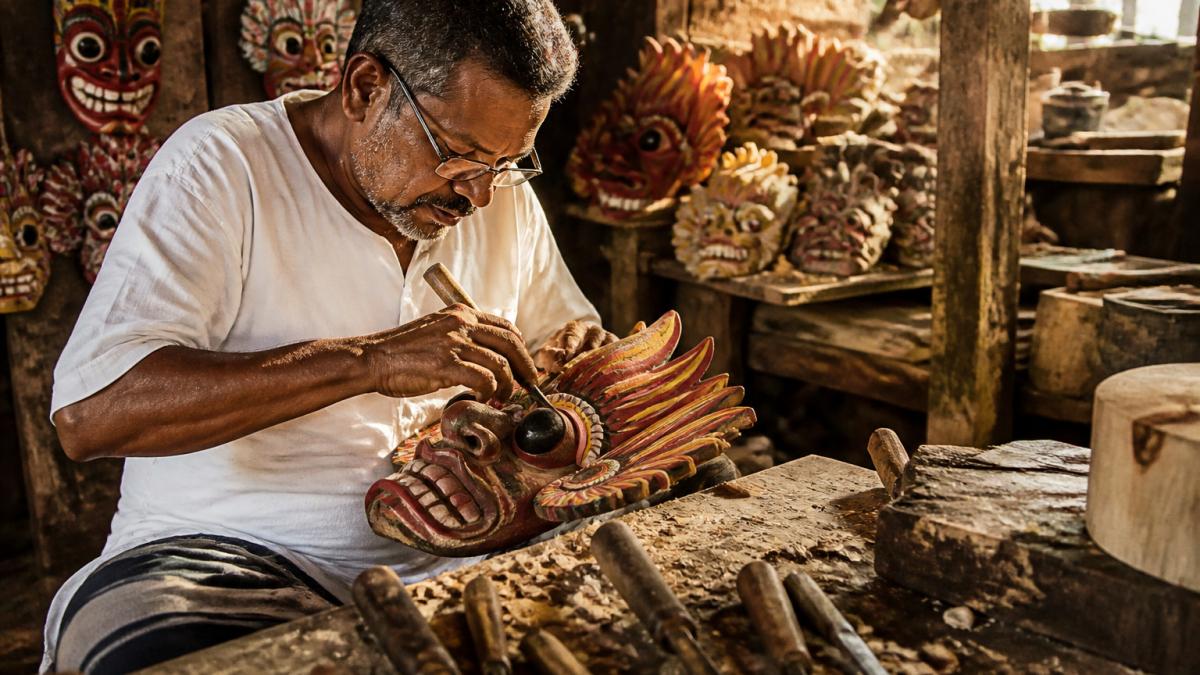
How Sri Lankan Masks Are Made: Carving, Materials and Finishing
Once carved, the mask is sealed and painted. Color plays a meaningful role, since each spirit's face is traditionally rendered in specific tones.
Buying an Authentic Daha Ata Sanniya Mask Set
When you buy a set, verify the basics first: that there are eighteen distinct masks, that each has its own design, and that the seller can describe where the pieces were made and who made them. For guidance on sourcing ethically made pieces, see buying ethical art from Sri Lanka. Ask about materials and finishing, and look for clear photographs of each mask.
Ask any seller about the artisan and the materials before you order Sri Lankan art online.
A complete set can be purchased in one piece. The Complete Daha Ata (18) Sanni Mask Wall Hanging - Vibrant Demon Series brings all eighteen masks together on a single mahogany wood panel, priced at $1,919.99. If you are looking for a smaller grouping, the Kapala Sanni and Gini Jala Sanni Mask Wall Hanging - Vibrant Demon Series is priced at $289.99.

The broader collection of authentic Sri Lankan masks for sale is a good place to browse pieces before you decide.
Frequently Asked Questions
What are Daha Ata Sanniya masks?
Daha Ata Sanniya masks are a set of eighteen carved masks used in the Sanni Yakuma, a traditional Sinhalese devil dance ritual in Sri Lanka. Each mask represents one of eighteen spirits believed to cause a specific illness, and performers wear them to drive those ailments out of the body. Today they are also displayed as decorative wall art, with complete sets often mounted on a single Mahogany wood panel.
What does Daha Ata Sanniya mean?
Daha Ata Sanniya translates roughly to the eighteen sanniya, referring to the eighteen spirits or demons, called sanni, that the tradition holds responsible for human illness. The number eighteen is central to the practice, as each sanni is linked to a distinct malady. The term describes both the spirits themselves and the complete set of masks that represent them in the healing ceremony.
How many masks are in the Daha Ata Sanniya tradition?
The tradition includes eighteen masks, one for each sanni. Examples include the Maru Sanni, associated with convulsions and contortions of the face and eyes, and the Kapala Sanni, linked to madness and delirium. Because each mask targets a different ailment, a full set is considered necessary to address the complete range of illnesses in the belief system.
Where can you buy authentic Sri Lankan masks?
Authentic Sri Lankan masks are available from curated online galleries that feature original works by Sri Lankan artists. AARTZY offers a Complete Daha Ata (18) Sanni Mask Wall Hanging on a Mahogany wood panel for $1,919.99, along with individual pieces such as the Maru Sanni and Naga Sanni set, the Kapala Sanni and Gini Jala Sanni set, and the Deva Sanni and Vata Sanni set, each priced at $289.99. Buyers should check that a listing names the artist and describes the materials and origin.
