
Last Updated: November 5, 2026
Quick Summary
Interpreting religious symbolism in South Asian art means reading each figure's posture, hand gestures, attributes and setting, then checking those clues against the tradition the work comes from. Hindu, Buddhist and Islamic art each use their own visual vocabulary, so identify the tradition first. Confirm every reading with at least two visual clues.
- Identify the tradition first, because the same symbol can carry different meanings in Hindu, Buddhist and Jain contexts.
- Read the hands, since mudras and held objects are usually the strongest carriers of meaning.
- Confirm each interpretation with at least two visual clues rather than relying on a single symbol.
- Respect Islamic art's own logic, where meaning often lives in patterns, calligraphy and geometry.
Table of Contents
Religious symbolism in South Asian art is not decoration. Every hand position, object, color and animal in a sculpture or painting carries a set of meanings that were understood by the community that made it. Sri Lankan artists whose pieces draw on these traditions show how much a single image can hold. Learning to read it changes how you look at the work. The same attention to symbolism in cultural art can extend from sacred gestures and animals to the ocean motifs that carry meaning in Chamorro traditions.
Western art history often asks what a painting looks like and who made it. South Asian religious art asks a different question: what does this figure do, and what does it mean to the viewer? A deity may be shown with multiple arms, each one holding an object or making a gesture that stands for protection, blessing or the removal of obstacles.
This is why interpreting religious symbolism works best as a reading skill, not a guessing game. The rest of this guide gives you a method you can use on any piece.
A common mistake is treating every symbol as universal. For a deeper guide to identifying Daha Ata Sanniya masks and their meaning, see how to identify Daha Ata Sanniya masks and their meaning. A lotus means purity in one tradition, but its meaning shifts across Hindu, Buddhist and Jain contexts. Always ask which tradition a work belongs to first.
A Step-by-Step Framework for Visual Analysis
Use this simple sequence whenever you look at a piece. Work through it in order.
- Identify the figure. Is it a deity, a teacher, a narrative scene or an abstract motif?
- Note the posture. Standing, seated or dancing positions often signal a specific role or state.
- Read the hands. Gestures and held objects are usually the strongest carriers of meaning.
- Check the attributes. Weapons, animals, flowers and crowns each point to a particular story.
- Consider the setting. Halos, backgrounds and surrounding figures shape how the main subject should be read.
- Compare with the tradition. Confirm the reading against the religion the work comes from.
Watch out: guessing a meaning from one symbol alone often leads to a wrong reading. Confirm each interpretation with at least two visual clues.
Reading Hindu Symbols in Art
Hindu art uses a dense visual vocabulary. Deities are identified through iconography, which is the set of conventional features that tell the viewer who the figure is.
Gesture, Mudra and Attribute
Mudras, the hand gestures, are among the most important signals in Hindu imagery. A raised palm usually signals protection or reassurance, while an open, downturned hand often offers blessings or gifts. Attributes, the objects a deity carries, complete the reading. A weapon, a lotus or a drum each tells you something about the figure's role.
The Divine Ganesha painting from AARTZY depicts Lord Ganesha with a luminous, contemporary elegance, with flowing ornamental lines and a gentle yet powerful expression. The Asian deity piece, which draws on the ancient Hindu goddess tradition, is another option.


Reading Buddhist Symbols in Art
Buddhist art often depends on symbols rather than human forms, especially in its earliest periods.
Aniconic Symbols and Narrative Reliefs
Early Buddhist monuments frequently showed the Buddha through symbols such as an empty throne, a footprint, a wheel or a tree rather than a human figure. Narrative reliefs then tell longer stories from the Buddha's life and teachings. Reading these works means following the sequence of scenes and recognizing which symbol stands for which moment. The Buddhist purity painting from AARTZY is an example of an ancient Sri Lankan painting tradition.
Islamic Art Symbolism and Its Own Logic
Islamic art follows its own rules and should not be read through Hindu or Buddhist assumptions. Many traditions avoid depicting living beings in religious settings, so meaning often lives in patterns, calligraphy and geometry. Repeating forms can express the infinite nature of the divine, and inscriptions carry sacred words directly. Respect this logic and resist forcing human-figure readings onto work that was never meant to be read that way.
Comparing Traditions and Using Digital Symbol Tools
Once you understand one tradition, comparing it with another sharpens your eye. Place a Hindu deity beside a Buddhist teacher and note how each uses the hands, the halo and the surrounding space. You will start to see shared motifs, such as the lotus, alongside sharp differences in how they are used.
Digital tools can help with this comparison. Image search and online iconography databases let you match a symbol to its tradition quickly. Treat these tools as a starting point and check their results against a reliable source, since automated matches can be wrong.
Bringing a Symbol Home: Choosing Your First Piece
Interpreting a piece before you buy it makes the purchase more rewarding. Start with the questions buyers commonly ask before purchasing art online. If you plan to buy, learn how to verify original art online so you know the piece is genuine.
Look closely at the symbols in the work, then confirm the story with the artist or the listing. Pieces such as our Dance of the Cosmos painting, which depicts the Nataraja with its rich symbolism, reward this kind of close reading. Priced at $1,049.99, it is a piece for a living room or other home setting.
Ready to find a piece that speaks to you? Browse the AARTZY collection and choose a work whose symbols you can read and love.
Frequently Asked Questions
What are some examples of religious symbolism in art?
Common examples include the lotus, which in South Asian art often signals purity and the unfolding of consciousness; the mudra, a hand gesture that conveys a teaching, protection or blessing; and the halo or aureole, which marks a figure as sacred. Attributes such as a Ganesha's broken tusk or a Nataraja's drum also carry specific meanings. Reading these together, rather than in isolation, gives the clearest interpretation of a work.
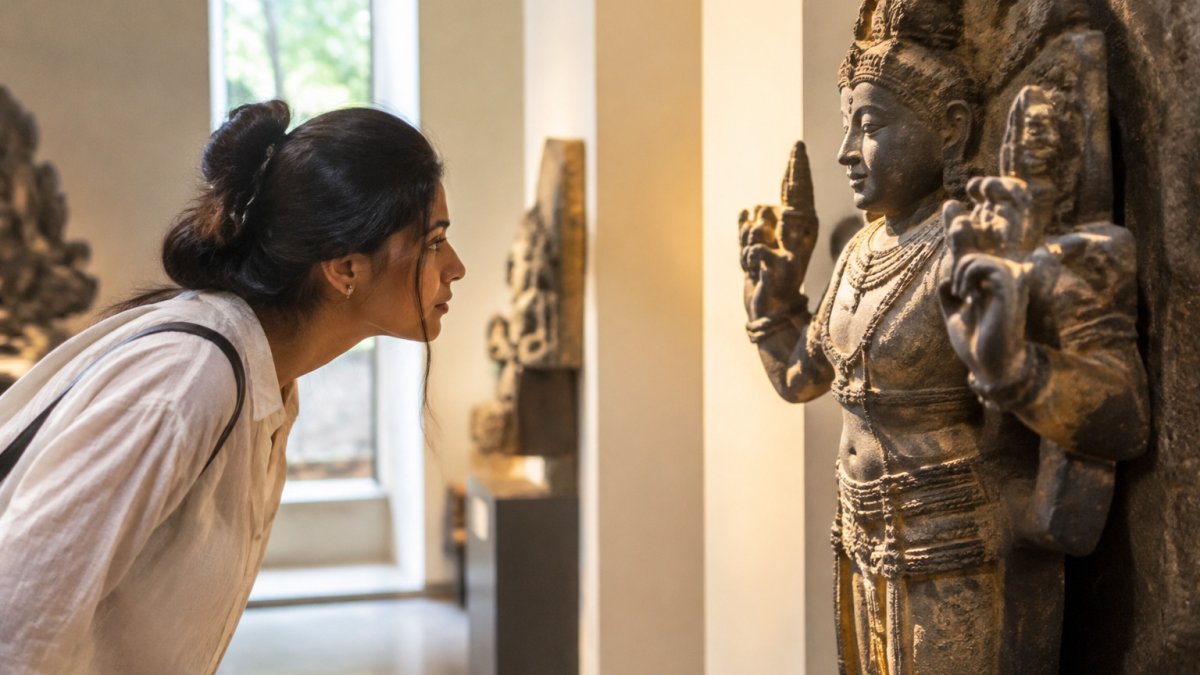
How can you identify religious symbols in South Asian paintings and sculptures?
Start with the figure's posture, hand gestures and objects, then check for a halo, a vehicle (vahana) or a seated pose that matches a known iconographic type. Compare the work against established iconographic texts and museum catalogues. Keeping a short notebook of recurring motifs helps you recognize them quickly across pieces and traditions.
How do Hindu and Buddhist symbols differ in South Asian art?
Hindu imagery typically centers on named deities with multiple arms, animal vehicles and elaborate attributes, while early Buddhist art often used aniconic symbols such as the footprints, the empty throne or the Bodhi tree to represent the Buddha. Both traditions share the lotus and mudras, so context and attributes matter more than any single motif. Note which tradition a work belongs to before drawing conclusions.
What does the lotus symbolize in South Asian art?
The lotus generally represents purity rising from muddy water, which parallels spiritual awakening in both Hindu and Buddhist art. It also appears as a seat for deities and as a symbol of creation in some Hindu narratives. Its meaning shifts with color, number of petals and whether a figure sits or stands upon it.
