
Last Updated: November 1, 2026
Quick Summary
The best platform to buy original art for investment is the one that protects your money, verifies what you buy, and makes the artist's share clear. Check the authenticity documents, returns terms, and fee breakdown before paying, since buying an original is permanent.
- Confirm the artist's signature, date, medium and dimensions in writing before paying.
- Request a certificate of authenticity or an equivalent written statement from the seller.
- Ask each platform what percentage of the sale price goes to the artist, in writing.
- Add up platform commission, shipping, tax and insurance to find your true total cost.
- Treat art as illiquid: plan a multi-year horizon and expect resale below purchase price.
Table of Contents
- Why Buying Original Art Online Is Not the Same as Buying Prints
- Is Buying Art Online Safe? What Protects You and What Doesn't
- How to Verify Art Authenticity Before You Pay
- Platform Types: Marketplaces, Dealer Sites, Auction Houses and Direct-From-Artist Routes
- Comparing Seven Platforms on Fees, Buyer Protection and Artist Sourcing
- Art Investment Risks and Fees: Total Cost, Returns and Resale Timelines
- Where Your Purchase Money Goes and How to Check It
- Choosing the Right Platform for Your Next Original Piece
- Frequently Asked Questions
Buying original art online has never been easier, but it has also never been easier to get it wrong when you buy original art without checking the details. For a US collector, the real question is not which platform looks prettiest. It is which one protects your money, verifies what you are buying, and makes the artist's share clear. This guide explains how to tell those apart, and why buying an original is different from buying a print.
Why Buying Original Art Online Is Not the Same as Buying Prints
An original is a single physical work, usually painted or drawn by hand, with no reproduction. A print is a copy, often produced in an edition. That difference drives price, resale value and risk.
The practical lesson is simple: judge originals on documentation, condition and the seller's track record, not just the image on screen. Photographs flatten texture, colour and scale, and a listing rarely shows the back of a canvas or the frame's condition.
Is Buying Art Online Safe? What Protects You and What Doesn't
Buying art online is generally safe when the seller is transparent and the payment method offers recourse, so when you buy original art you should confirm both before paying.
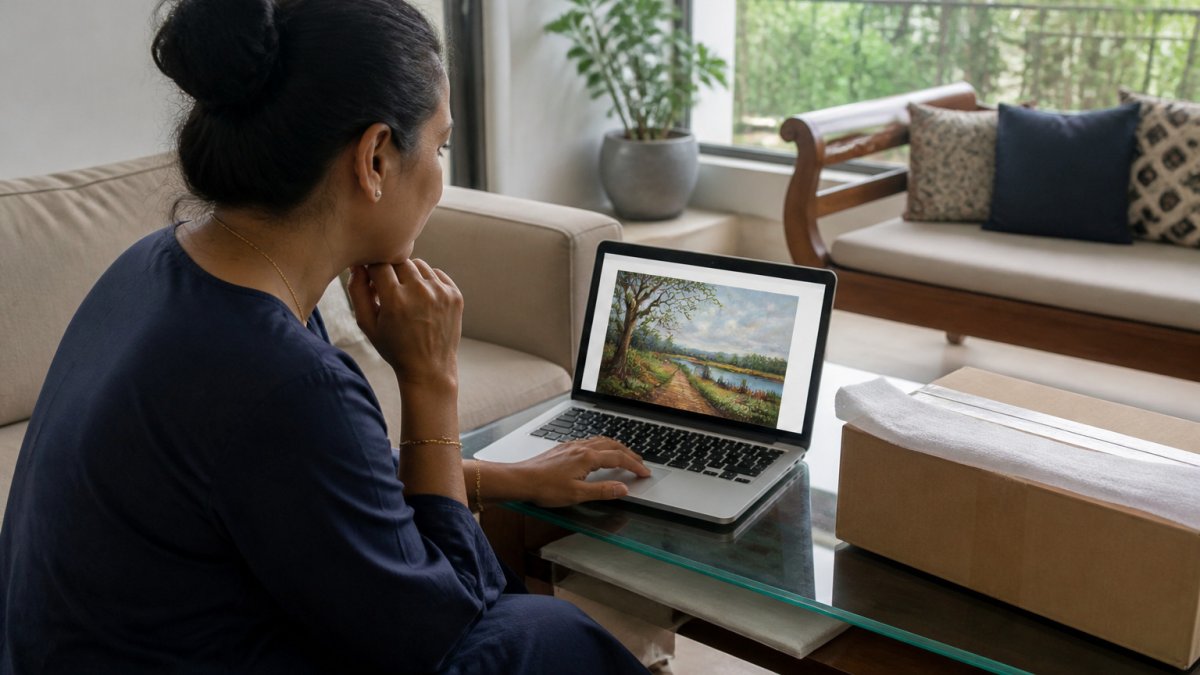
What often does not protect you: a marketplace that only passes payment through and disclaims responsibility for condition, or a seller who will not state the work's dimensions, medium and provenance in writing.
How to Verify Art Authenticity Before You Pay
Authenticity for an original means confirming who made it and that the document describing it is accurate. Start with the artist: look for a verifiable website, exhibition history, and consistent contact details.
Request a certificate of authenticity or an equivalent written statement from the artist or the platform. Our list of questions to ask before buying Sri Lankan art online covers what to request before you pay.
Platform Types: Marketplaces, Dealer Sites, Auction Houses and Direct-From-Artist Routes
Online buying routes fall into four broad groups:
- Open marketplaces host many sellers and offer wide choice, but quality and verification vary a great deal from listing to listing.
- Dealer and gallery sites curate their artists and usually handle condition, framing and shipping, at a higher price.
- Auction houses sell through bidding and publish estimates, buyer's premiums and condition reports, which makes costs easier to compare.
Each suits a different buyer. Pick the route that matches how much checking you are willing to do.
Comparing Seven Platforms on Fees, Buyer Protection and Artist Sourcing
A platform comparison is only useful if every platform is judged on the same criteria. The framework below lets you line up any seven sites, marketplaces, dealer sites, auction houses and direct-from-artist routes, on the things that actually affect your money and your rights. Fill it in for each platform you are considering; the answers, not the marketing copy, should drive your choice.
The comparison framework
Use these seven criteria for every platform:
- Ownership model. Are you buying a whole physical artwork, a print or edition, or a fractional interest? Confirm what you receive and what rights come with it.
- Fee transparency. Is the buyer-side fee stated before checkout, or buried in the price? Can you see the total, including shipping, tax and insurance, before you pay?
- Buyer protection. What is the returns window? Who handles a dispute over condition or authenticity? Does the platform insure transit, and does it stand behind the listing or merely pass payment through?
- Authentication and provenance practices. Does the platform require a certificate of authenticity, condition report, signature details and edition information? Does it verify sellers?
- Artist sourcing and network. Does it represent artists directly, aggregate third-party sellers, or sell on consignment? How large and how curated is the network?
- Resale and exit support. Does the platform offer consignment, buy-back or a secondary market? What commission applies?
- Total cost of ownership. Add purchase price, buyer's premium or commission, tax, shipping, insurance, framing and expected resale costs.
Apples-to-apples: whole artworks versus fractional interests
Do not compare a fractional share to an original painting as if they were the same purchase. A whole artwork gives you possession, control and a physical object you can insure and display. A fractional interest typically gives you a share in an entity, no possession, possible lock-up periods and platform-dependent resale. Price them separately, and judge each on the rights and costs attached to that model.
Due diligence checklist before you pay
Run this checklist for any platform and any listing:
- Seller identity and contact details verified
- Artist's signature, date, medium and dimensions stated in writing
- Certificate of authenticity or equivalent written statement provided
A platform that resists these requests is telling you something. Transparency on documentation is a better signal than any trust badge.
How to score the seven platforms
For each platform, record a simple pass or fail on each checklist item and a dollar estimate of total cost of ownership. Then rank the platforms on the criteria that matter most to you: budget, whether you want to possess the work, your risk tolerance and your investment horizon. A platform that scores well on protection and documentation but costs more may be the better choice for a first original; a low-fee marketplace may suit a buyer who is willing to do the verification work personally.
Where AARTZY fits the framework
Measure any platform's terms, including AARTZY's, against the other platforms you are considering using the same seven criteria, and ask for the fee breakdown and authenticity documentation in writing before you buy. For current prices and a full cost breakdown, check AARTZY's website or request a quote.
The framework below lets you compare platforms on the same criteria, so the answers rather than the marketing should guide your choice.
| Criterion | What to check | Why it matters |
|---|---|---|
| Ownership model | Whole artwork, print or fractional interest | Determines what rights you receive |
| Fee transparency | Buyer-side fee stated before checkout | Shows the true total you pay |
| Buyer protection | Returns window, dispute process, transit insurance | Defines your recourse if something goes wrong |
| Authentication | Certificate of authenticity, condition report | Confirms what you are buying |
| Artist sourcing | Direct, aggregated or consignment | Affects how much reaches the creator |
| Resale and exit | Consignment, buy-back, commission | Shapes what you recover later |
| Total cost of ownership | Price plus premium, tax, shipping, insurance | Gives the full outlay to compare |
Art Investment Risks and Fees: Total Cost, Returns and Resale Timelines
Most guides stop at "art can be risky." That is not useful. What matters is knowing where the money goes, how long it takes to get it back, and what ownership actually gives you. This section covers those mechanics so you can decide whether an original belongs in your plan at all.
The limits of art-market returns
Art is illiquid. A painting is not a stock: there is no exchange, no quoted bid, and no guaranteed buyer on any given day. Resale value depends on the artist's trajectory, the work's condition and provenance, and whether the right collector is looking when you decide to sell. Prices for individual artists can fall as easily as they rise, and a work bought at retail often resells at wholesale or below.
Whole artworks versus fractional interests
These are different products with different rights, and comparing them side by side is the most common mistake buyers make.
- Whole physical artwork. You own the object outright. You control possession, insurance, framing, storage and display. You can sell it, gift it or lend it, subject to any resale terms. You bear every carrying cost and every risk of damage or loss.
- Fractional interests. You buy a share of a work, usually held through a platform or entity. You typically do not possess the art, cannot display it, and may face lock-up periods, transfer restrictions, management fees and limited resale venues. Your return depends on the platform's valuation and its ability to sell, not on a market you can access directly.
Ask which model you are buying before you compare prices. A share priced at a few hundred dollars is not comparable to an original priced in the thousands, because the rights and costs are not the same.
Total cost of ownership
Budget the full outlay, not the sticker price. The components below apply to most purchases; confirm each platform's current published terms, because rates change.
- Purchase price or hammer price. What you pay for the work itself.
- Buyer's premium. Auction houses commonly add a percentage on top of the hammer price; the rate can differ by price band, so read the schedule.
- Platform or marketplace commission. Some sites add a buyer-side fee; others build it into the price.
Add these up before you decide. A work that looks affordable at checkout can carry meaningful carrying costs over the years you own it.
Resale routes and exit timelines
There is no single exit. Common routes include:
- Back to the platform or gallery. Some offer consignment or buy-back, often at a commission and subject to their discretion.
- Auction. Auction houses may accept a work for sale, but they set estimates, charge seller's commission and premiums, and the work may not sell at the reserve. Timelines can run from weeks to a full season.
- Private sale or dealer. A dealer may buy outright at a discount or broker the work for a fee.
In every route, expect the process to take time and to cost money. Build a realistic exit timeline into your plan, and assume the sale price may be below your purchase price.
A simple suitability check
Before you buy an original as an investment, answer these honestly:
- Can I afford to have this money tied up for several years?
- Do I understand every fee I will pay, both now and at resale?
- Have I confirmed the work's provenance, condition and authenticity in writing?
- Am I comfortable owning the object, with its insurance, storage and framing costs?
- Would I still be glad to own it if it never appreciated?
If any answer is no, treat the purchase as a collecting decision rather than an investment one.
Where Your Purchase Money Goes and How to Check It
If you want the artist to receive a meaningful share, ask each platform directly what percentage of the sale price goes to the creator, and get the answer in writing. Then add up every fee you will pay: platform commission, payment processing, shipping, and any tax.
Pricing depends on the artwork, its size and delivery details, so for current prices and a full breakdown, check AARTZY's website or request a quote.
Choosing the Right Platform for Your Next Original Piece
Start with your purpose. If you want a single piece for your home and a clear story behind it, a curated platform with direct artist information may suit you best. If you are building a collection, prioritise documentation, condition reporting and resale routes.
Before you commit, confirm the authenticity documents, read the returns and shipping terms, and check how the fees are calculated.
Frequently Asked Questions
Where can I buy original art online?
Original art is sold through several channels: curated online galleries, broad artist marketplaces, dealer websites, auction house platforms, and direct purchases from artists through their own websites or social channels. Each route differs in how much it charges, how it vets sellers, and how much it helps with shipping and returns. Before paying, check whether the seller states the artwork's origin, the artist's name, the medium and dimensions, and a written return policy. Pricing depends on the artwork, the artist, and the shipping destination, so request a written quote for the exact piece you want.
Is buying art online safe?
It can be, provided you buy from a seller that publishes clear contact details, a return policy, and a written description of the work. Look for secure payment processing, a traceable order history, and a seller who answers questions before you buy. Check whether the platform holds funds until delivery and whether it offers buyer protection for damaged items. Ask how the work is packed and insured in transit, because transit damage is the most common complaint with original pieces, especially sculpture.
How can I verify that an artwork is authentic?
Ask for a certificate of authenticity signed by the artist, a clear provenance record showing previous owners, and photographs of the signature and the back of the work. For works by established artists, a condition report and a documented exhibition history add weight. Be cautious with listings that rely only on stock photos or unverifiable artist biographies. Where the artist is living, you can often confirm the work directly with them or with the gallery that represents them.
What fees should I expect when buying art online?
Fees vary by platform and can include a buyer's premium, a commission built into the listed price, shipping and handling, insurance, import charges, and sales tax where it applies. Ask whether the price shown includes all of these. Some platforms charge the artist a commission, which means the buyer pays nothing extra but the artist receives less. Compare the total landed cost, not just the listed price, before deciding.
