
Table of Contents
- 1. Start with the Right Spot: Placement and Eye-Level Rules
- 2. Sculpture Pedestal Ideas: From Marble Bases to Floating Shelves
- 3. Lighting for Home Art Displays: Accent Techniques That Work
- 4. How to Style Shelves with Sculptures: Staggered Ledges and Negative Space
- 5. Displaying Sculptures on Coffee Tables and Mantelpieces
- 6. Structural Safety and Environmental Protection for Heavy Pieces
- 7. Small Spaces and Recessed Niches: Making Every Inch Count
- Frequently Asked Questions
Last Updated: September 14, 2026
1. Start with the Right Spot: Placement and Eye-Level Rules
The best way to display sculptures at home is to place them where the eye lands naturally, not where the wall happens to be empty, and the same logic applies when you display sculptures on a shelf or pedestal. A sculpture is a focal point, and focal points need breathing room, good sightlines, and a height that feels intentional.
Here is the rule most people get wrong: the center of a freestanding sculpture should sit at roughly eye level, or about 60 inches from the floor (Core Standards for Museums). That figure comes from museum practice, not guesswork. The American Alliance of Museums' standards for accessible display design treats that band as the zone where viewers engage with objects without strain.
The 2/3 Rule and Visual Balance
Visual balance is the principle that a sculpture should occupy roughly two-thirds of the height or width of the surface or space it sits within. A small bronze on an oversized console table looks lost. The same piece on a narrow floating shelf reads as deliberate.
Try this quick test before you commit to a spot:
- Stand three feet back and squint. If the sculpture disappears into the surrounding clutter, move it.
- Check the negative space around the piece. Empty area is part of the composition, not wasted room.
- Rotate the sculpture slightly. Most pieces have a "front," and most people never find it.
2. Sculpture Pedestal Ideas: From Marble Bases to Floating Shelves
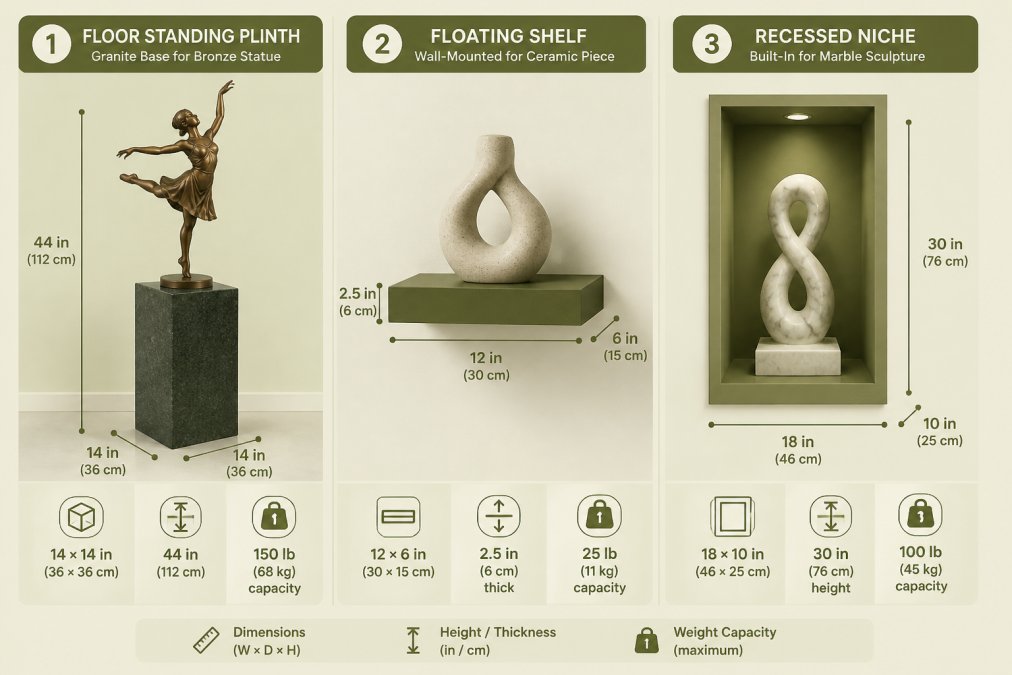
The right sculpture pedestal ideas depend on three variables: the weight of the piece, the fragility of the material, and how much floor space you are willing to give up. A bronze statue on a granite pedestal anchors a room. A small ceramic on a floating shelf keeps a hallway from feeling heavy. What most guides skip is the engineering underneath the look, and that is where pedestal choices actually succeed or fail.
Match the Pedestal Type to the Piece
- Floor-standing plinths and columns carry the most load and need no wall anchoring. A solid stone or hardwood plinth spreads weight directly onto the floor, which is why it is the default for anything over roughly 30 pounds. The trade-off is footprint: a 12-inch-square base eats floor space in a way a shelf never does.
- Floating shelves are the most misused option. A shelf's real limit is not the board, it is the bracket and the fasteners. A shelf anchored into wall studs with heavy-duty brackets holds far more than one hung on drywall anchors, which are typically rated for only a fraction of that load. Treat any floating shelf as a light-duty surface unless you have confirmed the mounting.
- Recessed niches remove the piece from the floor plan and give it built-in shadow and depth. Their constraint is the cavity itself: depth, width, and the fact that you cannot easily change the shelf height after the fact.
- Pedestal stands and risers (small acrylic, wood, or stone blocks) let you lift a piece a few inches on an existing surface without committing to furniture. They are the cheapest way to test a placement before you buy anything permanent.
Choosing Materials: Granite, Marble, and Wood
Material compatibility matters more than most guides admit. Marble bases suit stone and bronze pieces because the visual weight matches. Wood plinths pair well with ceramics and smaller mixed-media work, and they are far easier to move when you rearrange a room. Granite pedestals handle heavy sculpture without flexing, which is exactly what you want under load.
A common mistake is buying a pedestal that is too tall. A plinth should lift the piece into view, not tower over it. If the sculpture's base is wider than the pedestal top, the whole arrangement looks unstable even when it is perfectly secure.
The DIY-vs-Professional Line
This is the decision competitors leave out. A reasonable rule of thumb:
- DIY is fine for lightweight pieces on freestanding surfaces, small risers, and shelves you have personally verified are anchored into studs.
- Hire a professional when the piece is heavy, when it must be wall-mounted, or when you cannot confirm what is behind the drywall. A pro will locate studs, choose fasteners rated for the load, and confirm the wall can take it.
3. Lighting for Home Art Displays: Accent Techniques That Work
Lighting for home art displays follows one rule above all others: light the sculpture, not the room. Accent lighting directed at the piece creates the shadow and highlight that give sculptural form its depth.
Three approaches work well in a home setting:
- Picture lights mounted above a shelf or niche, angled down at 30 to 45 degrees
- Adjustable track or spot fixtures aimed from the ceiling, useful for larger freestanding pieces
- LED strip lighting hidden inside a recessed niche, which washes the piece without glare
Avoid placing a sculpture where direct sunlight hits it for hours each day. Ultraviolet exposure fades finishes and can degrade certain materials over time. The National Gallery of Art's guidance on light exposure for collection objects outlines how cumulative light exposure affects different media, and the same logic applies to your living room.
4. How to Style Shelves with Sculptures: Staggered Ledges and Negative Space
Styling shelves with sculptures is where most homes either shine or fall apart. The trick is staggered ledges and deliberate negative space, not a crowded shelf of objects fighting for attention.
Build a vignette in odd numbers. Three objects, five objects, never two. Group a sculpture with a book stack and a small bowl, and vary the heights so the eye travels. A curated collection reads as intentional; a row of similar-sized pieces reads as storage.
Use the "one hero" approach: pick a single sculpture as the focal point of the shelf, then let everything else support it. Floating shelves work especially well here because they remove the visual noise of brackets and legs.
5. Displaying Sculptures on Coffee Tables and Mantelpieces
Coffee table styling and mantelpiece display share a constraint: the surface is used for something else. A coffee table holds drinks; a mantelpiece sits above a fire. Both need sculptures that can take a light bump without disaster.
For coffee tables, choose a piece with a wide, stable base and keep it toward the center or a corner, never the edge. For mantelpieces, weight distribution matters. Place heavier pieces at the ends and lighter ones in the middle, and never let a sculpture overhang the mantel edge. A marble base on a mantelpiece is a safe pairing because the mass keeps the piece planted.
6. Structural Safety and Environmental Protection for Heavy Pieces
Structural safety for heavy pieces is the topic competitors skip, and it is the one that costs the most when ignored. A sculpture that weighs more than about 20 pounds should never sit on a floating shelf rated for decorative objects. Check the mounting hardware rating, not the shelf's appearance.
Weight Distribution and Tipping
Weight is not the only risk, balance is. A tall, narrow piece can topple even when it is light, and a heavy piece on a small base concentrates all its load on a tiny contact area. Two habits prevent most accidents:
- Lower the center of gravity. A wide, heavy base (stone, granite, or a weighted plinth) keeps a tall piece planted. If a sculpture feels top-heavy, it probably is.
- Anchor against tipping. In homes with children or pets, a freestanding piece on a shelf or mantel should be secured, museum putty, a mounting bracket, or a tether to the wall. A piece that can be nudged off an edge will eventually be.
- Keep heavy pieces off the edge. On any surface, push weight toward the wall or the center, never the lip.
How Materials React to Their Environment
Different sculpture materials fail in different ways, and the fix depends on which one you own:
- Bronze is durable but develops a patina over time. Humidity and airborne pollutants accelerate that change, and direct sun can alter the surface finish. A paste wax coating, reapplied periodically, slows it.
- Stone (marble, granite, alabaster) is porous. It stains from spills and absorbs moisture, and repeated humidity swings can stress it. Seal porous stone and keep it out of bathrooms and kitchens.
- Wood is the most humidity-sensitive. It swells and shrinks with moisture, which can crack a carving or open a joint. Stable indoor humidity matters more for wood than for any other common material.
- Ceramic and clay can crack from thermal shock, a sudden temperature change, like a piece near a drafty window or a heat source.
Light, Heat, and Placement
Ultraviolet light fades finishes and degrades some materials over time, and the effect is cumulative, brief daily exposure adds up over years. Keep pieces out of the path of direct sun, and rotate anything that sits in a bright spot. Heat is the other quiet threat: a fixture close enough to warm the surface can damage coatings and stress stone over months.
- Keep pieces out of bathrooms and kitchens, where humidity swings warp wood and stain stone
- Use a protective coating on outdoor or sunlit pieces, and reapply per the maker's guidance
- Felt or cork pads under a marble base prevent scratches and stop the piece from sliding
If you are unsure whether a wall can hold a piece, hire a professional to check for studs and load capacity. DIY mounting is fine for light work; heavy sculpture is not a weekend project.
7. Small Spaces and Recessed Niches: Making Every Inch Count
A recessed niche is the single best solution for displaying sculptures in a small space. It removes the piece from the floor plan entirely and turns a wall cavity into a display surface with built-in shadow and depth.
Where a niche is not available, use vertical space. A wall-mounted floating shelf above a doorway or beside a window adds display area without consuming floor. Keep the palette tight in small rooms: one sculpture, one accent light, one supporting object. A home gallery in a compact apartment works because of restraint, not volume.
Displaying sculptures well comes down to three things: correct height, honest weight limits, and light that reveals the form instead of flattening it. The pieces that look best in a home are the ones chosen with intention, and that starts with where they come from. AARTZY connects collectors with original sculptures, paintings, and prints from Sri Lankan artists, offering free worldwide shipping, secure payment processing, and a curated selection that is never mass-produced. Every purchase supports the artist directly. Browse the gallery and add to cart the piece that belongs in your space.
Frequently Asked Questions
What is the 2/3 rule for displaying art?
The 2/3 rule suggests that artwork or a sculpture should occupy about two-thirds of the available wall or surface space. For a pedestal, the sculpture itself should be roughly two-thirds the height of the pedestal. This proportion creates visual balance and prevents the piece from looking either lost or overcrowded. When you display sculptures, aim for this ratio to make the artwork feel intentionally placed rather than accidental.
How do I choose the right pedestal for a sculpture?
Match the pedestal's material and scale to the sculpture. A heavy bronze statue needs a granite or marble base that can support its weight, while a delicate ceramic piece works well on a slim wooden plinth. Consider the room's style: a modern interior pairs nicely with a sleek floating shelf, while a traditional space suits a classic column. Always check the weight capacity and use mounting hardware rated for the piece's mass.
What are the best lighting techniques for home sculptures?
Use accent lighting to highlight the sculptural form without washing it out. A adjustable spotlight from above at a 30-degree angle creates shadows that emphasize texture. For a bronze statue, warm white LED brings out the metal's depth. Avoid direct sunlight, which can fade patina or crack stone. If the piece is in a recessed niche, a small LED strip along the top edge gives a soft, gallery-like glow.
How can I display sculptures safely in small apartments?
In small spaces, use verticality and multi-purpose surfaces. A floating shelf above a desk or a staggered ledge along a wall holds small sculptures without taking floor space. Recessed niches between studs add display area without protruding. For heavier pieces, anchor shelves into wall studs using appropriate fasteners. Keep walkways clear and avoid placing sculptures on unstable surfaces like a narrow windowsill.