
Table of Contents
- What You'll Need Before You Pack
- Best Packing Materials for Fine Art
- Step-by-Step: Packing Fragile Art for International Shipping
- Is Climate Controlled Shipping Worth It for Prints?
- Customs Documentation for Shipping Artwork
- Insurance and Claims for Damaged Art
- Common Mistakes to Avoid
- Conclusion
- Frequently Asked Questions
Last Updated: September 13, 2026
What You'll Need Before You Pack
Protecting fragile art during international shipping starts before the box is sealed: the materials you gather and the condition checks you run determine whether a piece survives thousands of miles intact.
Before you touch a single sheet of wrapping, assemble the following:
- Archival, acid-free tissue and glassine paper for direct surface contact
- Rigid foam board or corrugated backing cut slightly larger than the artwork
- Foam corner protectors sized to the frame or canvas depth
- Bubble wrap or foam sheeting for the cushioning layer
- A double-wall or wooden crate for anything framed, glazed, or sculptural
- Moisture barrier film if the route crosses humid or rainy climates
- Packing tape, a tape gun, and nitrile gloves to keep oils off the surface
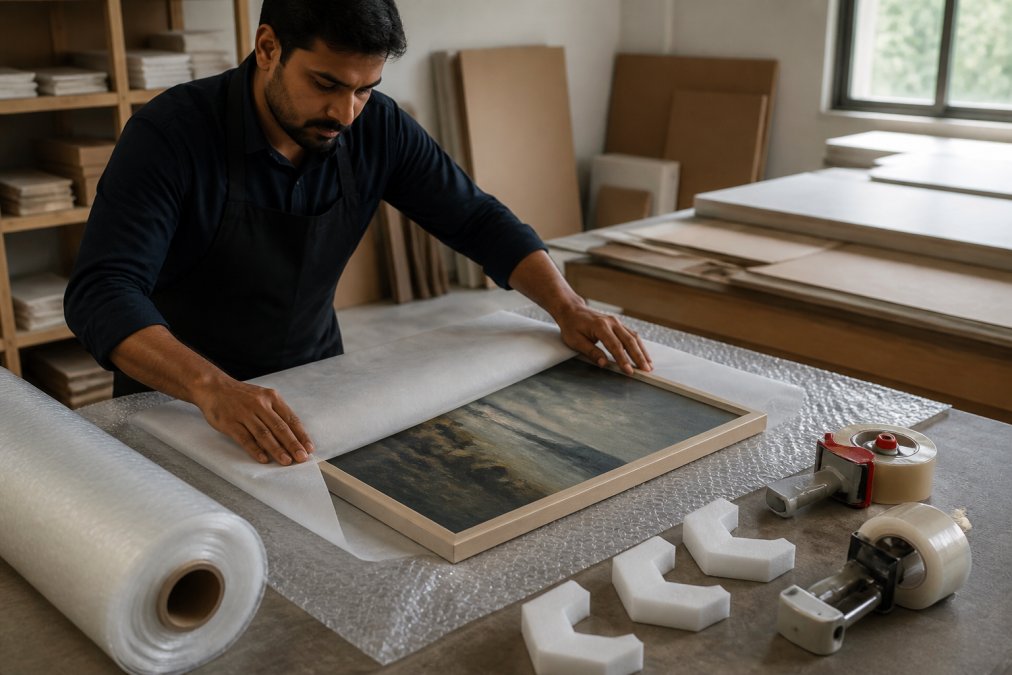
A common mistake is grabbing whatever bubble wrap and cardboard is closest. Standard bubble wrap leaves imprints on oil paint and acrylic, and recycled cardboard carries acids that migrate into paper (si.edu).
Best Packing Materials for Fine Art
The best packing materials for fine art balance three jobs: isolating the surface, absorbing shock, and blocking moisture. No single material does all three, so serious shippers build layers.
Archival and Acid-Free Essentials
Archival materials are acid-free and chemically stable so they do not discolor or degrade the artwork they touch. Glassine paper is the standard first layer for works on paper: smooth, non-abrasive, and breathable without sticking.
Use acid-free tissue between stacked prints, and back every unframed piece with rigid foam board to prevent bending. For brittle media such as pastel, charcoal, or aged paper, glassine is the only safe direct-contact layer. Tape should never touch the artwork.
Cushioning and Shock Absorption
Cushioning absorbs the vibration and impact of transit, keeping a dropped crate from cracking a frame. Foam corner protectors take the direct hits, while a foam or bubble layer spreads force across the surface.
The goal is a packed item that does not shift when you shake the box. If you hear movement, add material until the artwork is immobile.
Step-by-Step: Packing Fragile Art for International Shipping
Follow these steps in order, and do not skip the documentation stage. Each layer has one job, and reversing the sequence weakens the package.
Step 1: Protect the Surface
Lay the artwork face-up on a clean, padded surface and put on gloves. Cover it with a single layer of glassine or acid-free tissue, smoothing out wrinkles so no folds press into the paint.
For glazed frames, tape an X of low-tack tape across the glass to hold shards in place if it breaks. Add foam corner protectors, then wrap the piece in a cushioning layer, snug but not so tight it warps a canvas.
Step 2: Crate or Box for Impact Resistance
A custom crate built to the artwork's exact dimensions is the strongest option for framed pieces, sculptures, and anything high-value. Standard boxing works only for small, unframed prints that are already rigid.
Line the crate with a moisture barrier, set the wrapped artwork inside with foam blocks on all six sides, and confirm there is no play. Seal and label it as fragile and orientation-sensitive, and strap palletized crates so they cannot slide.
Is Climate Controlled Shipping Worth It for Prints?
Climate controlled shipping is worth it for prints when the route crosses extreme heat, freezing temperatures, or high humidity, because paper and canvas expand and contract with moisture and temperature swings. For short domestic hops in a mild season, standard freight is usually fine.
Long international routes are different. A print that travels through a hot container or humid port can arrive warped, moldy, or cockled despite careful packing. If your piece is valuable, original, or irreplaceable, temperature-managed service is cheap compared with a ruined work.
The trade-off: climate control adds cost and can slow transit, since fewer carriers offer it. For a low-value open-edition print, skip it. For a signed original or a piece with sentimental weight, it is the difference between arrival and arrival intact.
Customs Documentation for Shipping Artwork
Customs documentation for shipping artwork must declare the piece accurately, describe it clearly, and state its true market value. Vague paperwork is the most common reason art gets held at a border, and a hold means more handling and more risk. Precision in these declarations remains equally vital when shipping collectible figures, as any discrepancy in categorization or valuation invites unnecessary scrutiny that jeopardizes the integrity of the transit.
HS Codes: How Art Is Actually Classified
Art is classified under the Harmonized System (HS), a six-digit international code every destination country extends with its own tariff suffix. The first six digits are universal; the last two to four are national. For art, classification hinges on what the piece is made of, whether it is an original or reproduction, and whether it is signed or numbered.
The broad headings most shippers encounter:
- Chapter 97 covers works of art, collectors' pieces, and antiques. This is where original paintings, drawings, pastels, and collages generally land.
- Heading 9701 covers paintings, drawings, and pastels executed entirely by hand. Originals and hand-painted reproductions can fall under different subheadings within 9701, and the distinction matters for duty rates.
- Heading 9702 covers original engravings, prints, and lithographs, but only if they are the original impressions pulled from the plate, not later photographic reproductions.
- Heading 9703 covers original sculpture and statuary, in any material.
- Heading 9704 covers used postage stamps and similar collectibles.
- Heading 9705 covers collections and collectors' pieces of archaeological, historical, or numismatic interest.
- Heading 9706 covers antiques more than 100 years old.
A photographic reproduction of a painting is not Chapter 97 art, it is a printed image, and it classifies under Chapter 49 (printed books, pictures, and similar printed matter). That single distinction can swing the duty rate and whether the piece qualifies for any art-specific exemptions. Confirm the classification for your specific piece rather than guessing, and check the current rules through U.S. Customs and Border Protection guidance on importing art.
What the Commercial Invoice Must Contain
A commercial invoice that says "artwork" or "painting" invites a hold. It should read like a catalog entry and match the piece exactly:
- Artist name (and, if applicable, dates or nationality)
- Title of the work
- Year of creation
- Medium and support, for example, "oil on linen," "gouache on paper," "bronze with patina"
- Dimensions in both inches and centimeters, stated as height × width × depth
- Edition information if it is a print or multiple, edition size, impression number, and whether it is signed and numbered
- Country of origin, where the work was created, not where it is being shipped from
- Declared value in the transaction currency, with the currency code spelled out
- Purpose of shipment, sale, exhibition, return, gift, or repair
- HS code for the specific piece
The bill of lading covers freight terms, and the customs declaration tells the destination authority what is inside. Keep all three documents consistent, a mismatch between invoice and declaration is one of the fastest ways to trigger an inspection.
Temporary Shipments and Carnets
If the art travels for an exhibition, fair, or gallery loan and will return to its origin, an ATA Carnet may let it enter without duty or a temporary import bond. A carnet replaces customs paperwork for each country on the itinerary and is valid up to one year; it is issued by participating chambers of commerce, and the piece must return in the same condition within the validity window (cbp.gov). For a one-way sale, use a standard commercial invoice and declaration.
The Undervaluation Trap
Keep the declared market value honest. Undervaluing a piece to reduce duties voids most transit insurance, turning a damaged artwork into a total loss, and can trigger penalties, seizure, or retroactive duty assessment. The declared value should reflect an arm's-length sale price, supported by a recent appraisal, invoice, or comparable sale if questioned.
Insurance and Claims for Damaged Art
Transit insurance stands between you and a total loss, but it only pays if the paperwork is clean.
Carrier Liability vs. Separate Fine-Art Coverage
Carriers do not insure art; they assume limited liability. For most international freight, the default cap is set by weight or per-package limit and is almost always far below the value of an original work. Declaring a higher value on the air waybill or bill of lading raises that ceiling, but does not make the carrier an insurer, exclusions for improper packing, inherent vice, and delay still apply.
A separate fine-art policy, often written "wall-to-wall" or "nail-to-nail," covers the piece from the moment it leaves the wall until it is rehung at the destination. These policies typically cover the agreed value, not a depreciated figure, and respond to handling damage, theft, and some climate-related loss. The trade-off is cost and underwriting: the insurer will want a condition report, photographs, and a packing specification before binding coverage.
For anything worth more than a nominal amount, the practical answer is both: declare value with the carrier to raise its liability ceiling, and carry a separate policy for the gap.
What a Claim Actually Requires
If a piece arrives damaged, the claims process rewards preparation. Sequence matters because evidence collected out of order is often rejected:
- Photograph the unopened box from every side before you cut a single piece of tape. Carriers want to see the exterior condition as received.
- Photograph the damage as you unpack, layer by layer, so the packing method is visible.
- Keep all packing materials. Inspectors may ask to see them, and the materials are evidence of whether the packing met the standard you declared.
- File the claim within the carrier's stated window. For international freight this is often short, commonly measured in days, not weeks, so file a preliminary notice immediately and supplement it later.
- Submit your pre-shipping photos, the commercial invoice, the declared value documentation, and any condition report.
- Follow up in writing and keep a record of every exchange, including names, dates, and reference numbers.
Most denials trace back to poor packing or undervaluation, not carrier stubbornness. Document both properly and the claim is straightforward.
Why Claims Get Denied
The recurring denial reasons are predictable:
- Improper packing, the carrier argues the crate did not meet the standard for the declared value. This is why pre-shipping photos of the packed piece matter.
- Undervaluation, the declared value is lower than the actual loss, so the payout is capped at the declared figure.
- Inherent vice, the damage came from the artwork's own nature (brittle paint, unstable media) rather than transit. This is a common exclusion for older works.
- Late filing, the claim window closed before the paperwork was submitted.
- Unreported pre-existing damage, a condition report was never made, so the insurer cannot tell what was new.
The Condition Report Habit
A condition report is a written and photographic record of the piece's state before shipping, noting existing frame wear, craquelure, previous repairs, and loose or flaking media. Have it signed and dated, and keep a copy with the shipping documents. If a claim is filed, the report separates "damaged in transit" from "already like that." For high-value works, a professional conservator's report is worth the cost.
Common Mistakes to Avoid
The same errors sink shipments again and again, and nearly all are preventable with a few minutes of care.
- Reusing thin or dirty boxes that have already lost their structural strength
- Skipping the moisture barrier on routes through humid climates
- Letting tape touch the artwork and pull off paint or paper fibers on unpacking
- Declaring a low value to save on duties, which caps your insurance payout
- Using standard bubble wrap directly on paint and leaving permanent imprints
- Forgetting HS codes and watching a shipment sit in customs for weeks
- Packing loosely so the piece shifts and cracks a corner in transit
For eco-friendly alternatives, recycled and biodegradable cushioning performs well for many pieces, though archival contact layers should still be acid-free. Sustainability and protection are not in conflict if you choose the right materials for each layer.
Conclusion
Shipping fragile art across borders exposes it to handling, climate swings, and customs delays no single material can absorb. The fix is layering: archival contact materials, real cushioning, a custom crate, climate control where it counts, and documentation that holds up at the border.
AARTZY handles this work on every order. Our free worldwide shipping pairs with secure payment processing and friendly customer support that stays with you if anything goes wrong in transit. Every piece comes from verified Sri Lankan artists, so what arrives is authentic and worth protecting.
Get started with AARTZY and bring home original art that reaches your door the way it left the studio.
Frequently Asked Questions
How do I protect artwork when shipping?
Wrap the surface in glassine paper first, then add a moisture barrier and cushioning. Use foam corners for frames and pack the piece snugly so it cannot shift. For international shipments, a custom crate gives the best impact resistance. Always declare the full market value and buy transit insurance. If you buy from a gallery like AARTZY, ask how they pack and whether insurance is included before you add to cart.
What are the customs requirements for shipping artwork internationally?
You need a commercial invoice, a customs declaration form, and the correct HS code for the art. The invoice should state the artist, title, medium, year, and market value. Some countries require an export license or a certificate of origin. Keep a copy of all documents with the shipment and send digital copies to the buyer. Missing paperwork is the most common reason art gets held at customs.
What materials are best for protecting fragile art during transit?
Acid-free glassine paper protects surfaces without sticking. Bubble wrap and foam padding absorb shock, while foam corners protect frames. A rigid outer crate or double-wall box adds impact resistance. Use a moisture barrier like polyethylene sheeting for humid routes. Avoid newspaper and regular tape directly on the art, since the ink and adhesive can cause damage over time.
Do I need specialized insurance for international art shipping?
Standard carrier liability often caps out well below the market value of original art. Specialized fine art insurance covers the full declared value, including damage during loading, transit, and customs handling. Document the piece with photos before packing and keep receipts. If damage occurs, file a claim quickly with the bill of lading, photos, and a professional appraisal to support your case.