
Table of Contents
- Before You Buy: Essential Verification Tools and Setup
- Step 1: Check the Certificate of Authenticity Requirements
- Step 2: Identifying Giclee Prints vs Original Paintings
- Step 3: Art Provenance Research Tips for Online Buyers
- Step 4: Visual Inspection Techniques for Original Art
- Step 5: Verifying the Artist's Signature and Brushwork
- Step 6: Questions to Ask the Seller Before Buying
- Common Mistakes and Red Flags When You Verify Original Art Online
- Frequently Asked Questions
Last Updated: September 17, 2026
Before You Buy: Essential Verification Tools and Setup
Learning how to verify original art online starts with the right setup. You need a few simple tools before you spend money on any piece.
Here is what you need before you start:
- A phone or camera with a high-resolution lens
- A UV blacklight flashlight
- A magnifying glass or jeweler's loupe
- A ruler or tape measure
- Access to the artist's catalog raisonné or gallery records
Step 1: Check the Certificate of Authenticity Requirements
A certificate of authenticity is a signed document that confirms a piece is a genuine work by the named artist. It should list the artist, title, medium, dimensions, and date.
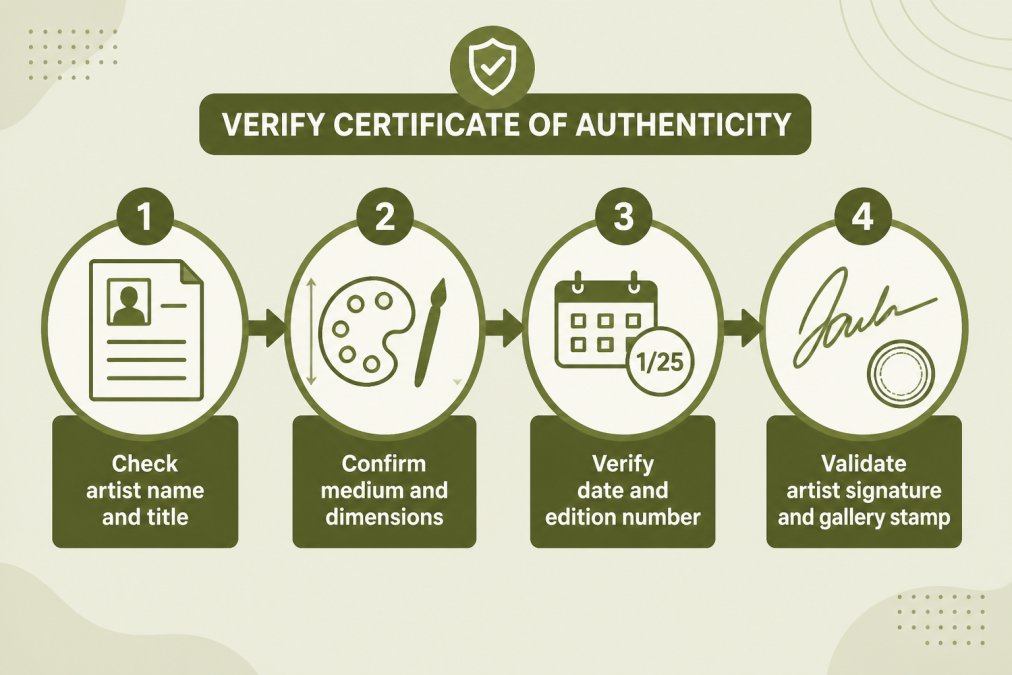
Check these items on any COA:
- Artist's full name and signature
- Title and creation date
- Medium used (oil, acrylic, watercolor)
- Exact dimensions
- Edition number, if it is a limited edition
- Gallery stamp or dealer contact
Step 2: Identifying Giclee Prints vs Original Paintings
A giclee print is a high-quality digital reproduction, not a hand-painted piece. It can look almost identical to a real painting in a small photo.
Look for these differences:
- Texture: Originals have brushwork and layering. Prints feel flat.
- Canvas weave: Real canvas shows a visible weave under light.
- Impasto: Thick paint ridges catch light at an angle. Prints cannot copy this.
- Edges: Hand-painted edges are uneven. Printed edges are sharp and uniform.
Step 3: Art Provenance Research Tips for Online Buyers
Provenance research means tracing a piece's ownership history from the studio to the current seller. A clean paper trail raises value and lowers risk. A broken one is not automatically fatal, plenty of legitimate works have gaps, but the gaps need a plausible explanation.
Start with these sources, in this order:
- Gallery records and receipts. Original invoices, consignment agreements, and dealer correspondence are the strongest links. Ask for scans, not photos of screens.
- Auction house archives. Major houses publish past-lot databases with photos, condition reports, and hammer results. Search the artist's name plus the title, then cross-check dimensions and medium against the current listing.
- Exhibition catalogs. A work shown in a museum or gallery show is usually listed with its lender at the time, which anchors the ownership chain to a specific year.
- Insurance appraisals and condition reports. These documents describe the piece at a point in time and often include photographs that can be matched to the current work.
- The artist's catalogue raisonné. This is the definitive scholarly list of an artist's known works. If a piece is not in it, ask why, and be skeptical of any answer that does not involve a recognized addendum process.
How to read a provenance chain
A strong chain names a specific person or entity for each transfer, with a date or at least a year. Weak chains use phrases like "private collection" with no name, "acquired decades ago," or "from a family estate" with no supporting document. One vague entry is common. Three in a row is a pattern.
Digital provenance and blockchain registries
Digital provenance is now a real option, and it is the angle most guides skip. Some galleries and marketplaces log each sale on a blockchain ledger, which creates a tamper-evident record of custody. A few artists mint a token tied to a specific physical canvas and transfer it with the sale.
When provenance is thin
If the chain has real gaps, shift your weight to the physical evidence: signature, brushwork, materials, and any expert opinion you can obtain. A conservator or a specialist at a regional auction house can often date canvas, stretcher bars, and pigments well enough to confirm or rule out a claimed period. That kind of hands-on review is not free, but it is far cheaper than buying a fake.
Step 4: Visual Inspection Techniques for Original Art
Visual inspection catches what paperwork misses. Use a UV light to spot repairs, overpainting, and modern inks.
Then check the back of the canvas:
- Old labels and stamps
- Stretcher bar wear
- Signature or title written on the reverse
Step 5: Verifying the Artist's Signature and Brushwork
Signature verification starts with comparison. Find known signatures in the artist's catalog raisonné or on museum websites.
Step 6: Questions to Ask the Seller Before Buying
Ask direct questions and watch for vague answers. Honest sellers welcome due diligence.
Run through this list:
- Can you send more photos, including the back and edges?
- Do you have a certificate of authenticity?
- What is the full ownership history?
- Will you confirm the sale in writing?
- What is your return policy if an appraisal fails?
Common Mistakes and Red Flags When You Verify Original Art Online
Most bad buys come from rushing. Slow down and check every claim. The red flags below are the ones that show up again and again in buyer complaints and small-claims filings.
Watch for these red flags:
- No COA, or a COA with no contact details for the issuing gallery
- Prices far below recent auction comparables for the artist
- Blurry photos that hide texture, edges, and the back of the canvas
- A seller who refuses close-ups or a live video walkthrough
- Pressure to pay outside a secure platform, by wire, gift card, or crypto
- A listing that reuses photos from another seller's page (run a reverse image search)
- A "limited edition" with no stated edition size or numbering
Spotting AI-generated art sold as hand-painted work
AI-generated art adds a new problem, and most guides have not caught up. Some sellers now pass AI images off as hand-painted originals, and the tells are different from traditional forgery signs.
Look for these patterns:
- Brushwork that is too even. Real brushstrokes vary in width and pressure. AI textures repeat at regular intervals when you zoom in.
- Nonsensical details. Hands with the wrong number of fingers, jewelry that merges into skin, text that dissolves into gibberish, or background objects that do not resolve into anything.
- Impossible lighting. Highlights that fall on the wrong side of a form, or shadows that do not match a single light source.
- Symmetry that is too perfect. AI tends to mirror details that a human painter would vary.
- No physical evidence. Ask for a video of the piece from multiple angles, with the seller's hand or a coin in frame for scale. AI images cannot hold up under real-world lighting and detail.
What to do if you bought a fake
This is the part most articles skip. If you paid for an original and later learn it is a reproduction, a forgery, or an AI-generated image, you have options, and the clock matters.
- Document everything immediately. Save the listing, all messages, the payment receipt, and photos of the piece as received. Screenshot the seller's profile before it disappears.
- Stop communicating off-platform. Move the conversation back into the marketplace's messaging system so the platform has a record.
- File a dispute with the payment method. Credit card issuers generally allow chargebacks for goods not as described, and major card networks set their own dispute windows. PayPal and most marketplaces have their own buyer protection processes with their own deadlines.
- Send a written demand. A short, factual letter or email asking for a full refund within a set number of days creates a paper trail and often resolves the issue without further steps.
- Report the seller. USA.gov consumer complaint resources explains how to file a report with the appropriate federal, state, or local agency. The FTC also accepts reports on deceptive advertising and online sales practices.
- Consider small claims court. For amounts within your state's limit, small claims is often the fastest and cheapest path. You do not need a lawyer, and a documented paper trail is usually what decides the case.
The bottom line on red flags
When you verify original art online, patience beats speed every time. A seller with nothing to hide will answer questions, send more photos, and put promises in writing. A seller with something to hide will stall, deflect, or push you to close the deal fast. The behavior is often the clearest signal you will get.
| Red Flag | What It Means | What to Do |
|---|---|---|
| No COA | No proof of origin | Ask for one or walk away |
| Blurry photos only | Texture is being hidden | Request daylight close-ups and a video |
| Price too low | Likely a print, fake, or AI image | Compare to recent auction results |
| No provenance | Unknown ownership history | Research before you pay |
| Off-platform payment request | Avoiding buyer protection | Pay only through the marketplace |
| Reused listing photos | Possible scam | Run a reverse image search |
Frequently Asked Questions
Do all original artworks come with a Certificate of Authenticity?
Not always. While a COA is a standard document in the art market, many artists sell original work without one, especially at early career stages or through informal channels. If a COA is missing, ask the seller for alternative proof such as gallery receipts, exhibition records, or a signed statement from the artist. You can still verify original art online by examining provenance, signature, and material details. A COA strengthens confidence but is not the only path to authentication.
How can I tell if a painting is an original or a print?
Look for texture and surface depth. Original paintings often show brushwork, impasto, or canvas weave that you can see in raking light. Giclee prints tend to have a flat, uniform surface and may show a fine dot pattern under magnification. Check the edges: originals usually have paint that wraps or stops naturally, while prints often have a clean white border. Ask the seller for high-resolution photography of the surface at an angle. If the price seems too low for a hand-painted work, it is likely a print.
What are the red flags when buying art from online marketplaces?
Be cautious if the seller refuses to provide additional photos, avoids questions about provenance, or pressures you to pay outside the platform. Other warnings include a COA that lacks specific details, a signature that looks printed rather than hand-signed, and a price far below market for a known artist. Check seller reputation and return policy. If the listing uses generic stock images instead of photos of the actual piece, treat it as a major red flag. Trust your instincts and walk away if something feels off.
Can I use reverse image search to check if art is original?
Yes, reverse image search is a useful first step. Upload the artwork photo to Google Images or TinEye. If the exact image appears on multiple sites, it may be a print or a reproduction. However, many original works are not indexed online, so a lack of results does not guarantee authenticity. Use reverse image search alongside provenance research and visual inspection. It is one tool in your due diligence kit, not a final verdict.
Buying art online carries real risk, but the right gallery removes most of it. AARTZY connects you with original paintings, prints, and sculptures from Sri Lankan artists, each with a clear story behind it. Every piece comes with free worldwide shipping, secure payment processing, and friendly customer support if anything goes wrong. Get started with AARTZY and add a verified, one-of-a-kind piece to your collection.