

Is Contemporary Abstract Art a Smart Way to Collect?
Last Updated: November 9, 2026
Quick Summary
Contemporary abstract art can be a smart way to collect because it offers flexibility, many price points and direct purchasing from living artists. Buyers protect their investment by confirming the medium, verifying the artist and judging each piece on its formal qualities.
- Confirm whether a listing is an original, a limited edition print or a reproduction before comparing prices.
- Verify the artist exists independently by checking their own website and verifiable exhibition references.
- Judge a piece on color application, line, composition and texture, not only on personal reaction.
- Originals generally cost more than prints because each one is unique and made by hand.
- Ask the seller who made the work, where it was produced and what the return policy is.
Table of Contents
- What Contemporary Abstract Art Means Today
- A Short History From Mid-Century to Now
- Contemporary Abstract Artists Worth Knowing
- How to Value Abstract Art Before You Buy
- How to Verify an Original Painting Online
- Originals Versus Contemporary Abstract Art Prints
- Choosing Your First Piece for Your Home
- Frequently Asked Questions
Contemporary abstract art is one of the most flexible ways to build a collection that actually fits your home, and it does not require a museum-level budget to start. Abstract work from living artists is sold directly through online galleries and studios, so buyers can compare pieces without leaving their couch. AARTZY curates original paintings, prints and sculptures from Sri Lankan artists, and the points below apply to buying contemporary abstract art anywhere.
What Contemporary Abstract Art Means Today
Contemporary abstract art is non-representational work made by living or recently active artists, in which color, line, form and texture carry the meaning instead of a recognizable subject. It is not a single style. It includes gestural painting, hard-edged geometric work, soft color fields and mixed-media pieces that borrow from printmaking.
For a buyer, the practical distinction is between a piece's age and its approach. "Modern" usually refers to abstraction developed in the early and mid-twentieth century, while "contemporary" points to work made now. Many collectors use the terms loosely, so when you shop, read the artist's bio and the date on the listing rather than relying on labels alone.
A useful way to judge a piece is by three things: how the color is applied, how the composition holds the eye, and whether the surface shows deliberate decisions. Abstract work that looks effortless often took the most rework.
A Short History From Mid-Century to Now
Abstraction did not arrive all at once. It moved through a sequence of recognizable phases, and knowing that sequence helps you place a contemporary piece in a lineage rather than judging it in isolation.
The mid-century break came with Abstract Expressionism, the loose label for the New York painters who made the canvas an event rather than a picture. Two broad approaches emerged. Gestural painters such as Jackson Pollock and Willem de Kooning built surfaces through action and mark-making, while Color Field painters such as Mark Rothko and Barnett Newman used large, soft-edged areas of color to create an immersive, contemplative effect. Both strands rejected recognizable subject matter, but they arrived at very different surfaces.
By the late 1950s and 1960s, the focus narrowed again. Post-Painterly Abstraction and Hard-Edge painting, associated with artists such as Ellsworth Kelly and Frank Stella, pushed toward crisp edges, flat color, and shaped canvases. Minimalism went further, reducing art to simple geometric forms and industrial materials. In parallel, Op Art used optical effects to make flat surfaces appear to vibrate.
The 1970s and 1980s brought a reaction. Neo-Expressionism returned gesture and visible brushwork, while Pattern and Decoration and feminist abstraction challenged the idea that serious abstraction had to be austere. Artists began incorporating found materials, textile references, and political content into abstract forms.
Since the 1990s, the field has widened rather than narrowed. Digital tools, printmaking, and mixed media allow artists to combine hand-made marks with mechanical and photographic processes. Artists from many countries, including Sri Lanka, now show work online alongside painters trained in traditional studio settings. This widening is the reason buyers have more choice at more price points than earlier generations did.
For a collector, history matters mainly because it explains why certain techniques look the way they do. A hard-edged geometric piece descends from Kelly and Stella; a soft, layered color field descends from Rothko; a dense, all-over gestural surface descends from Pollock. Knowing where a style came from makes it easier to tell an artist building on that lineage from one copying its surface. That distinction also helps when weighing how an artist’s lineage carries into original abstract paintings, where HALABURDA can serve as a point of comparison for the choices made on canvas.
Watch out: a listing that calls a piece "Abstract Expressionist" when it was made last year is using a historical label as a marketing term, not a description of the work's date or movement.
Contemporary Abstract Artists Worth Knowing
Rather than chase names, look for artists with a consistent body of work, a clear statement about their process, and a record of exhibitions or sales that you can check. Read whether buying from unknown artists is safe before you commit. Emerging artists often offer the strongest value, because their prices have not yet reflected their growth.
When you research any artist, check whether the work appears on their own site and in verifiable exhibitions.
A common mistake is buying from the artist with the most followers. Read what makes art authentic and valuable to judge a piece on its merits. Social reach and artistic consistency are different things, and a quiet studio practice can produce stronger work.
How to Value Abstract Art Before You Buy
Value in abstract art has two layers: what the work is worth on the market, and what it is worth to you. Most buying guides cover only the first. This section covers both, because abstract work rewards a closer look than almost any other category.
Start with formal analysis. Before you decide whether you like a piece, read it the way a painter would. Look at color: is it applied in flat areas, in transparent washes, or in thick, visible strokes? Look at line: are the edges sharp and deliberate, or soft and blurred? Look at composition: does the eye move across the surface in a clear path, or does it settle in one area? Look at texture: can you see the weave of the canvas, the ridge of a brushstroke, the grain of a woodcut? These are the decisions the artist made, and they are what separates a resolved work from an unresolved one.
Then separate personal response from formal judgment. A piece can be formally strong and still not suit your room, and a piece can match your sofa perfectly while being weakly composed. Most practitioners find it useful to note their first reaction, then set it aside and ask whether the work holds up on the formal points above. If it does both, it is a strong candidate.
On the market side, price reflects the artist's track record, the medium, the size, the materials, and the piece's condition. Original paintings generally cost more than prints because each one is unique and made by hand. Prints still have value, but their price reflects the edition and production method. Compare like with like: a large original acrylic on canvas should be compared to other originals of similar size and medium, not to a small framed print.
Watch for these points before you commit:
- Medium: Confirm whether the work is an original, a limited edition print, or a reproduction.
- Materials: Ask what paints, papers, or supports were used and how long they are expected to last.
- Certificate or documentation: Reputable sellers provide information about the artist and the work.
- Return policy: A seller who stands behind the piece will say so in writing.
Watch out: a low price on an "original" from an unknown seller is often a print or a reproduction, so confirm the medium before comparing prices. A common pattern is that the cheapest listing in a search is the one with the vaguest description.
The article lists the points to check before committing to a piece.
| Check | What to confirm | Why it matters |
|---|---|---|
| Medium | Original, limited edition print, or reproduction | Confirms the price basis |
| Materials | Paints, papers, or supports used | Shows expected longevity |
| Certificate or documentation | Information about artist and work | Signals a reputable seller |
| Return policy | Written terms from the seller | Shows the seller stands behind the piece |
How to Verify an Original Painting Online
Verification is the step most buyers skip, and it is the step that protects you. Begin by confirming the artist exists independently of the listing. Search for their name alongside exhibition or gallery references, and check whether their own website and social accounts show the same work.
Next, examine the listing itself. For a step-by-step checklist, see the verification guide. Look for clear photographs of the front and back, dimensions in both centimeters and inches, a description of the medium and the signature. Be cautious of listings that use a single stock image, or that describe work in vague terms such as "in the style of."
Finally, ask the seller direct questions and note the answers. A legitimate seller will tell you who made the work, where it was produced and what their return policy is.
Originals Versus Contemporary Abstract Art Prints
An original is a single work made by the artist, while a print is a reproduction, even when the artist supervised it. Prints can be an affordable entry point, especially for work by artists you want to follow, but they do not hold the same scarcity or resale value as originals.
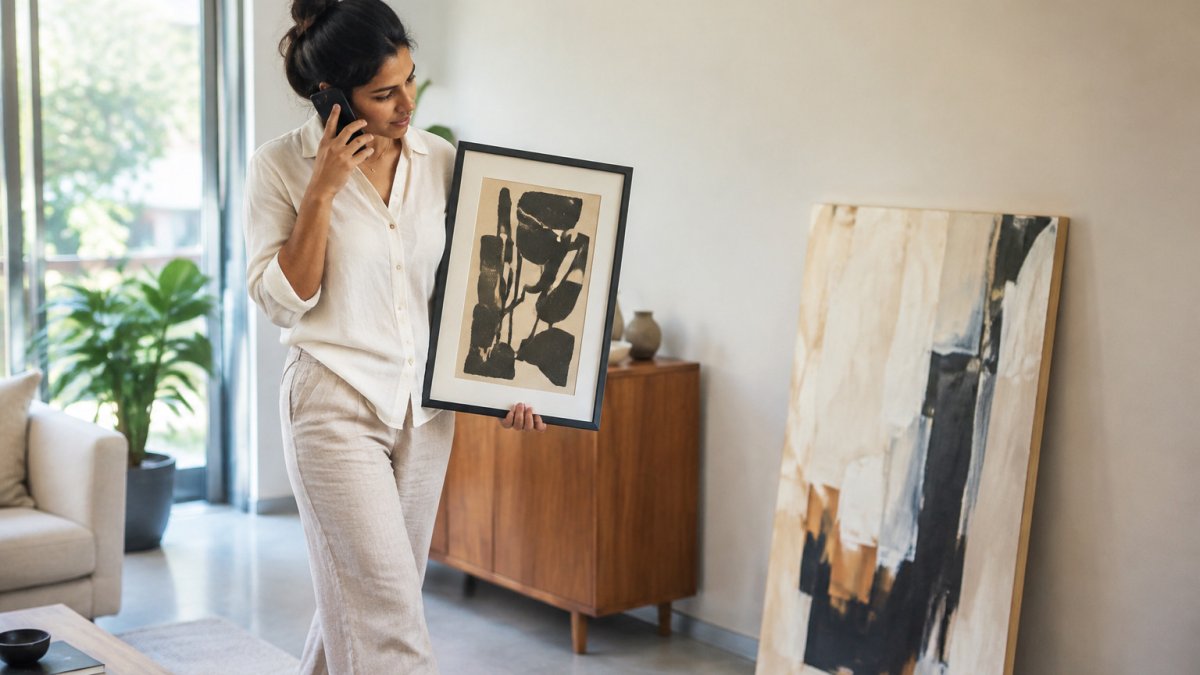
Choose an original when you want the physical texture, scale and unrepeatable marks that only the hand-made piece offers. Choose a limited edition print when budget is the main constraint and the image itself matters most to you.
Abstract woodcut and screen prints can carry rich, layered surfaces, so a print is not automatically the lesser option. Check the edition size and whether the artist signed each piece.
Choosing Your First Piece for Your Home
For a first purchase, pick one space in your home and one piece that suits its light and color palette. Measure the wall, allow room around the frame, and consider whether a large canvas or a smaller piece will sit better with your furniture.
Bold, high-contrast abstract works suit open living areas, while softer color fields work well in bedrooms. If you want a starting point, AARTZY's current picks include Movement & Depth, a woodcut print with dominant black, yellow and red tones, priced at $539.99. Colorful Chaos, a bold woodcut in red, yellow, blue and black, is also $539.99. Blossoms in Abstraction is an acrylic on canvas in soft pink and orange at $489.99. All three ship free worldwide with tracking.

Best for: buyers who want a statement piece for a living room or entryway. Skip if: your budget is fixed below $400 and you need a smaller, lower-cost work.
Contemporary abstract art can be a sound way to collect when you buy with a clear eye. If you are new to collecting, the beginner's guide to starting walks through the first steps. Confirm the medium, check the artist, and choose work that you will still enjoy on the wall in five years.
Frequently Asked Questions
What is contemporary abstract art?
Contemporary abstract art refers to non-representational work made roughly from the 1970s to today, where color, form, line and texture carry the meaning instead of recognizable subjects. It includes painting, printmaking and sculpture by living or recently active artists. Collectors often start by looking at how an artist handles composition and color across a body of work, then decide whether that voice suits their space.
How is contemporary abstract art different from modern abstract art?
Modern abstract art usually describes the early twentieth-century movements that first broke from representation, such as Kandinsky and the Abstract Expressionists. Contemporary abstract art covers work made more recently, often by artists working with new materials, digital tools and mixed techniques. The line is loose, so check the artist's dates and the work's date when you research a specific piece.
How can you tell if an abstract painting is original?
Ask the seller for the artist's signature, the date, the medium and dimensions, and any certificate of authenticity. Look at the back of the canvas or the edges for stretcher bars, brushwork and hand-applied materials, which prints usually lack. Reputable platforms state whether a work is an original or a reproduction in the listing, so confirm that before paying.
Are contemporary abstract art prints worth collecting?
Prints can be a practical entry point because they cost far less than originals and let you live with an artist's work. Signed, numbered limited editions tend to hold value better than open or unnumbered reproductions. Buy prints from the artist or an established publisher, and treat them as art you enjoy rather than a guaranteed investment.
