
Table of Contents
- What You'll Need Before You Ship a Fragile Sculpture
- Step 1: Wrap and Cushion the Sculpture for Transit
- Step 2: Custom Crating for Fine Art vs. Standard Boxing
- Step 3: Prepare Art Shipping Customs Documentation
- Step 4: Meet International Art Shipping Insurance Requirements
- Step 5: Choose Air Freight or Sea and Manage Climate Control
- Common Mistakes When Shipping Fragile Sculptures Internationally
- Frequently Asked Questions
Last Updated: October 1, 2026
What You'll Need Before You Ship a Fragile Sculpture
Shipping fragile sculptures internationally starts long before the box is sealed: the right materials, paperwork, and travel plan. Whether you buy from a gallery or ship your own work, the rules are the same: protect the surface, control movement, and document everything.
Before you touch the sculpture, gather these items:
- Nitrile gloves (never bare hands on painted or polished surfaces)
- Acid-free tissue paper and glassine sheets
- Archival foam ( polyethylene or Ethafoam), not cheap packing peanuts
- Bubble wrap and stretch film
- A sturdy double-wall box or custom crate
- Packing tape, strapping, and "Fragile" labels
- A camera for condition photos
- Shipping and customs paperwork
Step 1: Wrap and Cushion the Sculpture for Transit
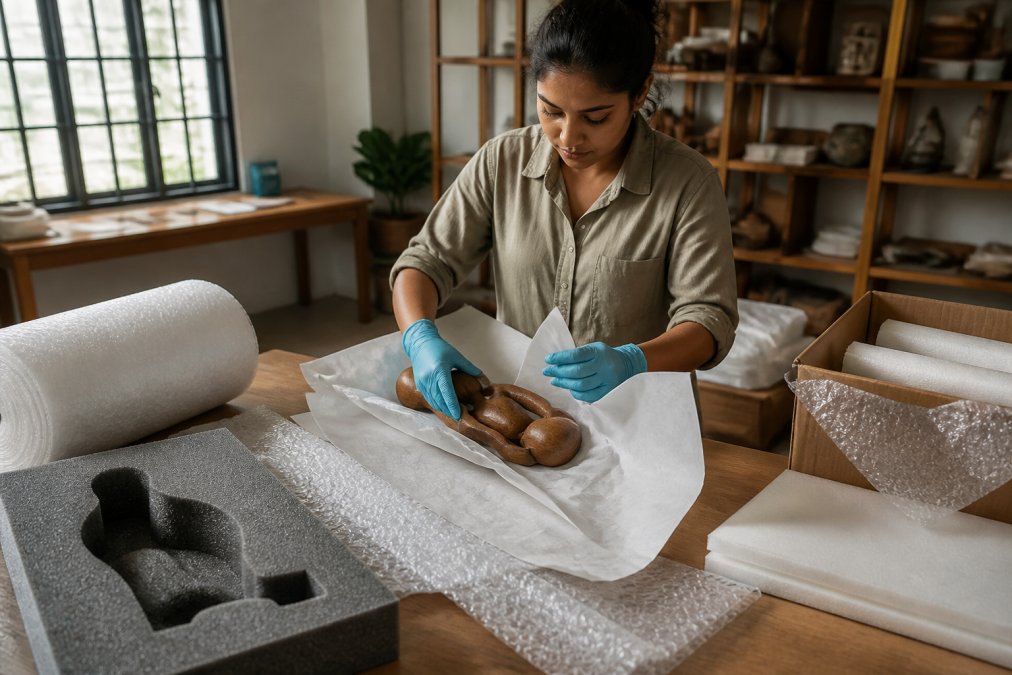
Wrapping is where most damage is prevented or caused. The goal: hold the sculpture still, protect every surface, and build shock-absorbing layers that don't press on delicate parts.
Choosing Archival and Acid-Free Materials
Archival materials protect both the surface and the value of the piece. Acid-free tissue and glassine go against the sculpture first, then a soft foam layer, then bubble wrap as the outer cushion. For metal pieces like [AARTZY's Amazing Creations](https://aartzy.com/products/amazing-creations), a soft cloth wrap prevents scratches.

Building Foam Inserts and Cushioning Layers
Custom foam inserts stop movement, the real enemy. Cut foam to match the sculpture's shape so it cannot shift, and leave at least 5 centimeters of cushioning on every side. For a piece balanced on a bar, like AARTZY's Flying Fire Machine, support the base and balance point separately.

Step 2: Custom Crating for Fine Art vs. Standard Boxing
Custom crating for fine art is the single biggest upgrade you can make. A standard box works for small, sturdy pieces. A crate is built for anything heavy, irregular, or valuable. Crates hold their shape under stacking pressure. Boxes crush.
A good crate includes:
- A wooden frame with foam-lined interior
- A floating mount so the sculpture never touches the outer wall
- Handholds and clear "this side up" markings
- A sealed inner liner for moisture control
DIY Crating vs. Professional Crating Services: A Cost-Benefit Look
DIY crating saves money upfront but shifts all risk onto you. A professional crating service builds to transit standards and often handles insurance paperwork. The trade-off:
| Factor | DIY Crating | Professional Crating |
|---|---|---|
| Upfront cost | Lower | Higher |
| Time needed | Several hours | Minimal |
| Insurance acceptance | May face questions | Widely accepted |
| Best for | Small, low-value pieces | Heavy or high-value work |
| Risk level | Higher | Lower |
Step 3: Prepare Art Shipping Customs Documentation
Art shipping customs documentation is where international shipments stall. Missing or wrong paperwork can hold a sculpture at the border for weeks, and a misclassified piece can trigger unexpected duty, a seizure review, or a forced return at your expense. Prepare before pickup:
- A commercial invoice with the full value and a clear description of the piece
- A packing list describing each item, its dimensions, and its weight
- A certificate of origin (or a signed statement of origin if no formal certificate exists)
- An export declaration, filed electronically through the Automated Export System (AES) when the shipment meets the filing threshold
- A bill of lading or air waybill matching the invoice exactly
HS Codes for Sculptures: How to Classify Original Art
Most guides skip this step, yet it decides whether your sculpture clears in a day or sits in a bonded warehouse. The Harmonized System (HS) is the international naming system every customs agency uses to assign duty. Sculptures and original art generally fall under Chapter 97, but the subheading matters more.
The two subheadings you will see most often are:
- 9703, original sculptures and statuary, in any material, produced by an artist. This is the classification for a one-of-a-kind or limited-edition original work.
- 9705, collections and collectors' pieces of archaeological, historical, or ethnographic interest. This applies to antiquities and certain cultural objects, not to contemporary studio work.
A few practical rules:
- Match the HS code on the commercial invoice to the HS code on the export declaration. Mismatches are the most common cause of holds.
- Describe the piece in plain language on the invoice, material, dimensions, whether it is an original, and the artist's name, not just a product title.
- If the destination country has a free trade agreement with the United States, the certificate of origin determines whether duty drops to zero. Get it right before the crate leaves the studio.
- Confirm the current code with U.S. Customs and Border Protection and, for the destination side, the equivalent customs authority. Codes are revised periodically, and a code that was correct two years ago may not be today.
Valuation, Duty, and the Under-Declaration Trap
Customs duty is calculated on the declared value of the sculpture, not the shipping cost. Declaring a low value to reduce duty is the most expensive mistake here: it caps your insurance payout at the declared amount and, if customs audits the shipment, exposes you to penalties and seizure. Declare the full replacement value, and make sure the invoice, insurance certificate, and packing list all show the same number.
Working With a Customs Broker
For any shipment above a few thousand dollars, or into a country with strict cultural-property rules, a licensed customs broker earns their fee: they file the entry, post duty, and handle a customs hold without the shipment being returned. Ask two questions before you commit: which HS code they intend to file, and the total landed cost including duty, taxes, and brokerage fees.
Step 4: Meet International Art Shipping Insurance Requirements
International art shipping insurance requirements vary by carrier and value. Most policies need a declared value, proof of professional packing, and condition photos. Underinsuring to save on premiums is a costly mistake: if the piece is lost, you recover only the declared amount.
- Does it cover the full replacement value?
- Does it cover damage, not just total loss?
Step 5: Choose Air Freight or Sea and Manage Climate Control
Air freight is faster and gentler on transit time. Sea freight costs less but exposes the piece to weeks of temperature and humidity swings, plus the cycling of a container on a dock. For delicate materials, climate control matters more than speed, and the right target depends on what the sculpture is made of.
Temperature and Humidity Targets by Material
No single setting works for every sculpture. The table below reflects the ranges most conservators and fine art logistics specialists work within. Treat them as planning targets, not guarantees, and confirm high-value pieces with a conservator.
| Material | Temperature target | Relative humidity target | Primary risk |
|---|---|---|---|
| Bronze and cast metal | 65-72°F, stable | 40-50% RH | Corrosion and patina bloom in damp air; rapid temperature swings cause condensation on cold metal |
| Unfired or low-fired clay | 65-72°F, stable | 45-55% RH | Cracking and spalling when humidity drops too fast; clay is the most humidity-sensitive common sculpture material |
| Resin and polymer cast | 60-75°F | 35-55% RH | Warping and surface bloom in sustained heat; resin softens above roughly 120°F in a closed container |
| Wood | 65-72°F, stable | 45-55% RH | Cracking, warping, and joint separation as moisture content changes; wood moves with humidity, not against it |
| Painted or gilded surfaces | 65-72°F, stable | 45-55% RH | Blistering, flaking, and pattern transfer from packing materials in heat |
| Stone and marble | 60-75°F | 40-60% RH | Thermal shock cracking; stone tolerates humidity better than wood or clay but not rapid temperature change |
Air vs. Sea: What Each Mode Does to the Climate Inside the Crate
- Air freight moves the piece in a temperature-controlled or semi-controlled hold, usually within 24-72 hours door to door. The exposure window is short, so the crate's buffering materials carry the piece through. This is the default for clay, resin, and painted work.
- Sea freight puts the sculpture in a steel container for two to six weeks. Containers on deck see full sun and can exceed 100°F inside; below deck, high humidity and condensation. For bronze and stone, sea freight is often acceptable with a sealed liner and desiccant. For wood, clay, and painted surfaces, it is a calculated risk that only pays off if the crate is genuinely climate-buffered.
- Climate-controlled ground and air, some fine art logistics providers offer temperature-controlled trucks and monitored air cargo. The most expensive option, and the right one for museum-grade or six-figure pieces.
Building a Climate-Buffered Crate
- A sealed inner liner. Wrap the sculpture in a vapor barrier, polyethylene sheeting taped at the seams, so outside air exchanges with the crate slowly rather than freely. This is the highest-impact step.
- Desiccant packs. Silica gel or clay desiccant inside the liner absorbs moisture that would otherwise condense on cold metal or stone. Use enough to cover the crate's internal volume, and replace them if the crate is opened mid-transit.
- Foam as thermal mass. Archival foam (polyethylene or Ethafoam) both cushions and insulates. Thicker foam walls slow temperature change, which is why a well-built crate holds a stable internal climate for hours longer than a box.
For a wood piece like AARTZY's Unfinished Work, a climate-controlled option protects the grain and joints. For bronze, the priority is keeping the patina dry. Match the crate to the material, not the shipping budget.

Common Mistakes When Shipping Fragile Sculptures Internationally
Most damage traces back to a handful of avoidable errors:
- Using newspaper or cheap packing peanuts that shift and stain
- Skipping the floating mount inside the crate
- Declaring a low value to reduce duty, which caps your insurance payout
- Forgetting the HS code or leaving it blank
- Shipping without condition photos
- Choosing sea freight for a humidity-sensitive piece to save money
Frequently Asked Questions
Do I need custom crating for international sculpture transport?
Yes, custom crating is strongly recommended for fragile sculptures. A custom-built wooden crate with foam inserts holds the piece in place, absorbs shock, and protects against vibration during air freight or sea transit. Standard cardboard boxes rarely provide enough structural support for heavy or irregular sculptures. If you are shipping a piece like Aartzy's Unfinished Work or Amazing Creations, professional crating is standard. For smaller, lighter works, a double-walled box with foam may work, but a crate offers the highest level of damage prevention.
What documentation is required for shipping art overseas?
You will typically need a commercial invoice, a packing list, and a customs declaration form. For original artworks, a certificate of authenticity and a statement of value help with customs clearance. Depending on the destination, you may also need an export license or a carnet. Harmonized System (HS) codes classify the sculpture and determine duties. Always check the specific border regulations of the destination country, as requirements vary. Aartzy includes all necessary export documentation with every shipment to make international art shipping straightforward.
Is shipping insurance necessary for fragile sculptures?
Yes. International art shipping insurance requirements usually mean you should insure the sculpture for its full market value. Without coverage, a broken piece leaves you out the money. Most carriers offer limited liability, so a separate fine art policy or a rider on your homeowner's policy is wise. Document the condition before shipping with photos and keep all receipts. Aartzy professionally packages and securely ships every sculpture in a crate, and tracking is available, but insurance adds a critical layer of financial protection.
How much does it cost to ship a sculpture internationally?
Costs vary widely based on size, weight, destination, and speed. Air freight is faster but more expensive; sea freight costs less but takes weeks. Custom crating, insurance, and customs fees add to the total. For a mid-sized sculpture, expect several hundred to over a thousand dollars. Aartzy offers free worldwide shipping on all sculptures, which removes the shipping cost from your purchase. Always get quotes from multiple couriers and factor in crating and insurance when comparing.