
Table of Contents
- Online Gallery Commission Rates in 2026: A Full Breakdown
- Why Online Galleries Charge Commission (and Where the Money Goes)
- Hidden Costs Beyond Commission: What Artists Actually Pay
- How to Price Your Art for Galleries: The Math Behind the Markup
- Consignment Agreements for Artists: What to Check Before You Sign
- Is Buying Art Online Safe? What Collectors Need to Know
- Calculating Your Take-Home Pay: A Step-by-Step Example
- Frequently Asked Questions
Last Updated: September 29, 2026
Online Gallery Commission Rates in 2026: A Full Breakdown
How much commission do online galleries take? Most take between 20% and 50% of the sale price, with digital-only marketplaces landing in the 20-35% range and hybrid galleries charging 30-45%.
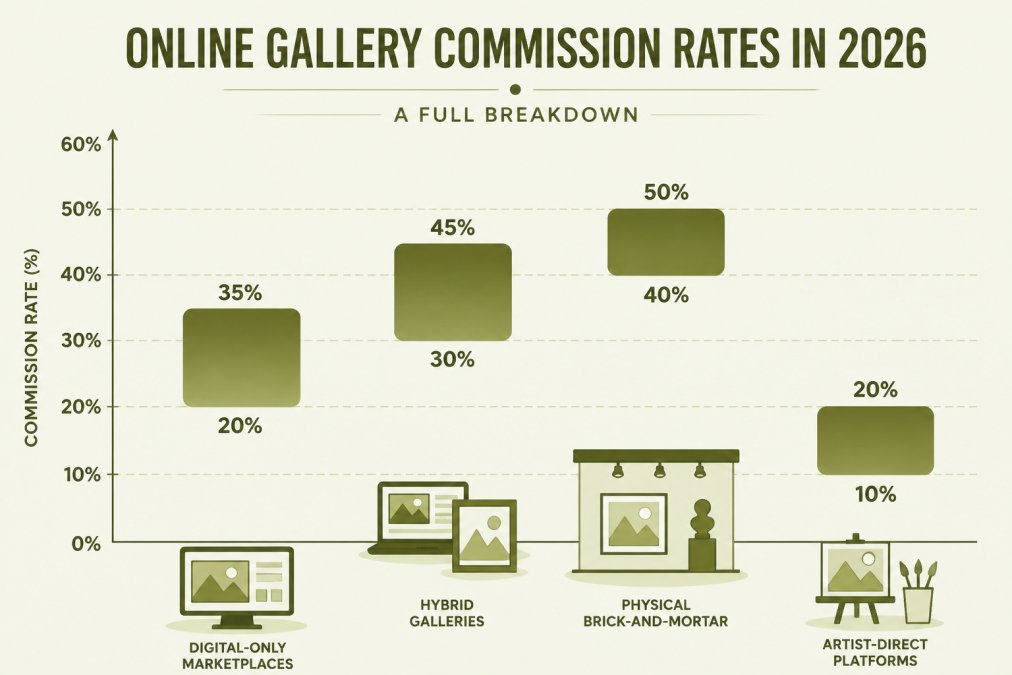
The range is wide because "online gallery" describes wildly different businesses.
U.S. Copyright Office guidance on visual artists' rights
Physical vs. Online Galleries: How the Numbers Compare
Physical galleries carry rent, insurance, staff, and exhibition costs. That overhead is why brick-and-mortar spaces often charge the highest commission, frequently 40-50%, while digital-only platforms can operate on thinner margins.
| Gallery Model | Typical Commission | What's Usually Included |
|---|---|---|
| Digital-only marketplace | 20-35% | Listing, payments, basic marketing |
| Hybrid gallery | 30-45% | Online storefront, curation, some promotion |
| Physical brick-and-mortar | 40-50% | Space, staff, exhibition, client base |
| Artist-direct platform | 10-20% | Hosting and transaction processing only |
Why Online Galleries Charge Commission (and Where the Money Goes)
Commission covers the cost of finding buyers. A gallery's job is client acquisition: building an audience, running the storefront, handling payment processing, and managing logistics to the collector. The percentage is a revenue-share on that labor, scaling with how much work the gallery absorbs.
Break a typical commission down and you'll usually find:
- Marketing and advertising spend to attract collectors
- Curation and photography to present work well
- Transaction fees from payment processors
- Shipping, handling, and insurance coordination
- Customer support and returns management
Tiered and Sliding-Scale Commission Structures
A flat rate is the simplest model, but many galleries, particularly hybrid and curated online platforms, use a sliding scale based on sales volume, price band, or career stage. The headline rate you are quoted may only apply to your first few sales.
Common patterns include:
- Volume tiers: the commission drops after an artist crosses a cumulative sales threshold in a contract year. A gallery might take 40% on the first $10,000 in sales, 35% on the next $15,000, and 30% above that.
- Price-band tiers: lower-priced works carry a higher percentage because the fixed cost of listing and shipping is the same whether a piece sells for $200 or $2,000. A gallery might take 45% on works under $500 and 30% on works above $2,500.
- Career-stage tiers: emerging artists sometimes pay a higher rate in exchange for heavier promotion, with the rate stepping down as the artist builds a collector base and sells more consistently.
- Consignment vs. wholesale: some galleries buy outright at a wholesale price (often 50% of retail) and resell at retail. That is a markup model, not a commission model, and it shifts inventory risk to the gallery.
What the Commission Does Not Cover
The commission is the gallery's share of the sale, not a warranty that it will sell anything, nor a promise of listings, shows, or promotions. Most agreements are non-exclusive on the gallery's side while the exclusivity clause may bind you. That asymmetry is normal, but it means the commission buys access to a marketplace, not a guaranteed outcome.
Hidden Costs Beyond Commission: What Artists Actually Pay
The commission is rarely the only deduction. Many agreements include line items that reduce net proceeds well below the headline rate.
Watch for these:
- Submission or jury fees charged per application, whether or not work sells
- Exhibition costs for physical shows, sometimes split with the artist
- Shipping and handling deducted from the sale before commission is calculated
- Transaction fees passed through on top of commission
- Photography or framing charges recovered from the artist's share
How to Price Your Art for Galleries: The Math Behind the Markup
Pricing for gallery representation means working backward from the retail price, not forward from your costs. The retail price is what the collector pays; your take-home pay is what remains after commission and deductions.
Consignment Agreements for Artists: What to Check Before You Sign
A consignment agreement transfers possession, not ownership: the artist retains title while the gallery sells on the artist's behalf, which is why these contracts carry obligations on both sides (consignment | Wex | US Law). Most disputes trace back to a clause that was vague, missing, or never discussed, not to outright bad faith.
Payment Schedule and Settlement Statements
The payment schedule is the clause most likely to be glossed over. "Net 30" means the gallery pays you 30 days after the sale; "Net 60" doubles that. "On receipt" means the gallery pays when the collector pays, immediate, or months if the collector is on a payment plan.
What the contract should specify:
- The trigger date: does the clock start on the sale date, the delivery date, or the collector's payment date?
- The settlement statement: a written accounting showing the retail price, the commission deducted, every pass-through fee, and the net owed to you. Ask to see a sample before signing.
- The payment method: check, ACH transfer, or platform balance. Platform balances can carry withdrawal minimums or processing delays that are not obvious from the commission rate alone.
- Late-payment terms: what happens if the gallery misses the window? Many agreements are silent, which leaves you with no contractual remedy.
Exclusivity Clauses: Scope, Territory, and Duration
An exclusivity clause is the most consequential term in a consignment agreement, and the one artists most often sign without narrowing. Exclusivity can be limited along three axes:
- Channel: does the gallery have exclusive rights to sell your work online, in person, or both?
- Territory: does exclusivity cover a specific region, the entire country, or worldwide?
- Category: does it cover all your work, or only a specific series, medium, or price band?
Loss, Damage, and Insurance
Who carries insurance, and at what valuation? The contract should state:
- Whether the gallery insures the work while in its possession, and at what declared value (retail price, wholesale price, or artist's cost).
- Who bears the loss if a piece is damaged in transit to a collector.
- The claims process and timeline if a piece is lost or destroyed.
Term, Termination, and Price Changes
- Term: how long does the agreement run, and does it auto-renew?
- Termination: how much notice is required to exit, and what happens to work already consigned?
- Price changes: who controls discounts, and can the gallery mark down your work without your consent?
- Post-termination: how long does the gallery retain the right to sell work already in its possession?
A termination clause requiring 90 days' notice and allowing the gallery to sell existing inventory for another 180 days can extend the agreement by most of a year. Read the tail.
FTC guidance on business contracts and disclosures
Is Buying Art Online Safe? What Collectors Need to Know
Buying art online is safe when the platform provides secure payment processing, clear authentication standards, and a defined process for damaged shipments. Risk sits with platforms that skip those protections.
Collectors should confirm four things before purchasing:
- The platform holds payment securely until delivery is confirmed
- There is a written policy covering damage in transit
- The artist's identity and body of work are verifiable
- Return or dispute terms are stated plainly
Calculating Your Take-Home Pay: A Step-by-Step Example
Work through the math before you agree to terms. Here is a simple sequence:
- Start with the retail price of the piece.
- Subtract the gallery commission percentage.
- Subtract any fees deducted before commission, if the contract says so.
- Subtract shipping and handling if the artist absorbs it.
- Subtract material and studio costs to find true profit.
Ask the gallery for a sample settlement statement from a recent sale, with the artist's permission. Seeing how deductions actually stack is worth more than any clause.
Frequently Asked Questions
What is the standard commission rate for online art galleries?
Most online galleries take between 20% and 50% of the sale price, with digital-only platforms often at the lower end and hybrid or physical galleries at the higher end. Some online marketplaces use tiered structures where the rate drops as your total sales volume rises. Always read the specific commission schedule in your contract, since rates can shift based on artwork price point, medium, and whether the gallery handles shipping and marketing.
Are there hidden fees beyond the standard online gallery commission?
Yes. Beyond the base commission, artists may pay for listing fees, photography, shipping and handling, transaction fees, marketing expenses, and exhibition costs. Some platforms also charge a fee to remove a piece from the site or to terminate a consignment agreement early. Ask for a full fee schedule in writing before signing, and calculate your net proceeds after every deduction, not just the headline commission percentage.
How does the 70/30 rule apply to art sales through online galleries?
The 70/30 rule is a common revenue split where the artist receives 70% of the sale price and the gallery keeps 30%. It is most common on digital-only platforms with lower overhead costs. Physical galleries often use a 50/50 split because they carry higher overhead for space, staff, and client acquisition. The split you get depends on what services the gallery provides, so compare the full package, not just the percentage.
What should I look for in consignment agreements for artists working with online galleries?
Check the exclusivity clause, the payment schedule, who covers shipping and handling, what happens if a piece is damaged in transit, and how either party can terminate the agreement. Confirm whether the gallery has the right to discount your work and by how much. Get the commission structure, any tiered rates, and all fees in writing. A clear consignment agreement protects both your income and your ability to sell elsewhere.