
Table of Contents
- Immediate Steps to Take When Art Arrives Damaged
- How to Document Damaged Artwork for Insurance
- Who Is Responsible for Transit Damage?
- Filing a Shipping Carrier Claim and Understanding Carrier Liability
- Art Shipping Damage Claim Template and Dispute Resolution
- Is Climate Controlled Shipping Worth It for Prints?
- Repair vs. Replacement: Evaluating Your Options
- Frequently Asked Questions
Last Updated: September 22, 2026
Immediate Steps to Take When Art Arrives Damaged
When art arrives damaged, your first hour decides whether your claim gets paid or denied. This AARTZY guide covers every step, from delivery truck to final resolution.
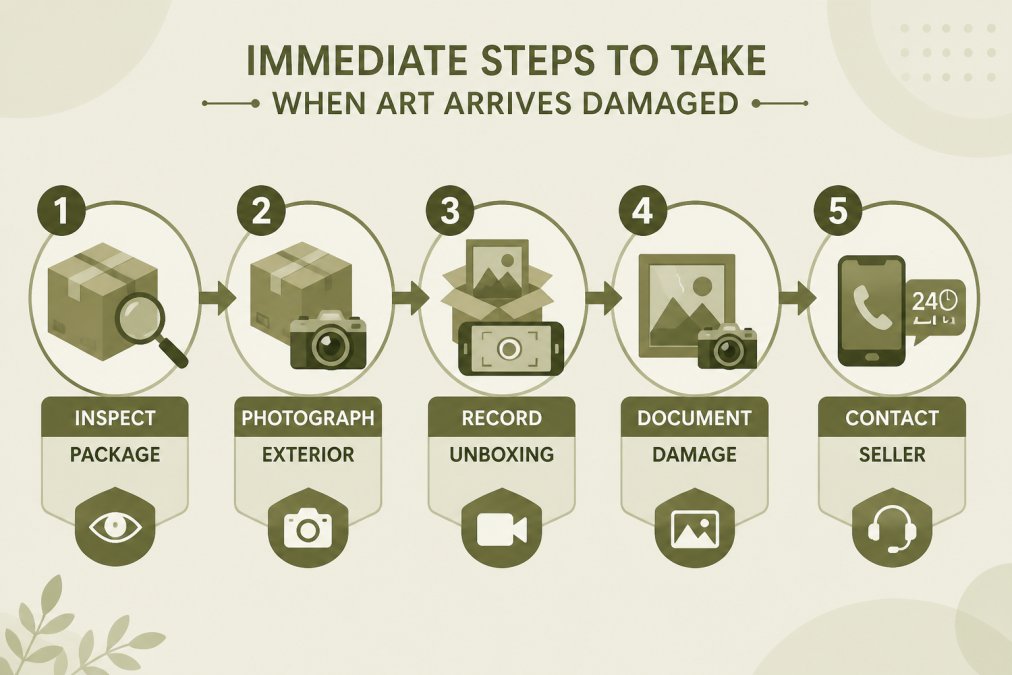
Here's the sequence that protects you:
- Inspect the package before you sign anything
- Photograph the exterior from every angle
- Record a full unboxing video
- Document the damage up close
- Contact the seller within 24 hours
Photograph the Box Before Opening
Photograph the box before touching the contents: all six sides, any dents, tears, or water stains, plus the shipping label and tracking number in one shot.
Record an Unboxing Video
An unboxing video is your best defense in any dispute. Start filming before you cut the tape and keep the box in frame throughout.
Your video should show:
- The unopened box with its shipping label
- The seal being cut for the first time
- Every layer of packaging as you remove it
- The artwork as it first appears
- The damage itself, in the same take
How to Document Damaged Artwork for Insurance
Documenting damaged artwork for insurance comes down to three things: clear photos, a written record, and proof of value. Miss one and your reimbursement can stall for weeks.
Gather these items:
- Photos of the box, inside and out
- The unboxing video
- Close-ups of the damage from multiple angles
- The original listing photos
- Your proof of purchase and receipt
- The bill of lading or shipping label
- Any tracking number records
What Photographic Evidence Is Required
Photographic evidence must show damage in context, not just a tight close-up. Shoot wide first, then move closer.
Follow this order:
- The full artwork, so the damage's location is clear
- A medium shot of the affected area
- A close-up of any cracks, tears, or frame damage
- A shot with a ruler or coin for scale
- The packaging that failed to protect the piece
Who Is Responsible for Transit Damage?
Responsibility for transit damage usually falls on the seller or carrier, not the buyer, but the exact answer depends on who arranged shipping, the terms, and how the piece was packed.
Here's the breakdown:
| Scenario | Likely Responsible Party | Why |
|---|---|---|
| Seller arranged shipping | Seller | Seller controls carrier and packaging |
| Buyer arranged shipping | Buyer | Buyer owns the shipping contract |
| Carrier mishandled the box | Shipping carrier | Carrier liability applies |
| Poor packaging by seller | Seller | Packaging standards not met |
| Damage hidden before shipping | Seller | Item was not as described |
Filing a Shipping Carrier Claim and Understanding Carrier Liability
Filing a shipping carrier claim starts with a phone call and written notice, usually within a short window after delivery. Miss it and the carrier can deny the claim outright. The biggest reason claims get denied isn't the damage itself, it's failing to prove the damage happened in transit rather than before the package was sealed.
Know the Default Liability Caps Before You File
Carrier liability is capped by default, and the caps are low. Without declared value or extra insurance, most carriers pay only a small amount per pound, often far less than the artwork's value. Declared value matters more than the label's weight class.
- Declared value is the amount you tell the carrier the shipment is worth. It usually costs extra and is the only way to recover the full value of original art.
- Default liability is what the carrier pays if you never declared a value. It is calculated per pound and rarely covers a one-of-a-kind piece.
- Third-party transit insurance is a separate policy sold by insurers and brokers. It often pays faster than a carrier claim and does not require you to prove carrier negligence.
The Claim Window Is Shorter Than You Think
Claim windows vary by carrier, but the pattern is consistent: the clock starts at delivery, not when you notice the damage. Some carriers require notice within days, others within weeks. File the same day you unbox.
To file a claim, you'll typically need:
- The tracking number and shipping label
- Photos and your unboxing video
- A damage assessment in writing
- Proof of value, such as a receipt or professional appraisal
- The completed claim form
Prove the Damage Happened in Transit, Not Before
This is the step almost every guide skips. Carriers and insurers deny claims when they can argue the damage existed before shipping. You defeat that argument with metadata, not adjectives.
Build the proof chain like this:
- Capture the listing photos before purchase. Save the seller's original listing images with their URLs and the date you saved them to show the piece's condition at sale.
- Photograph the sealed box on arrival. The capture timestamp proves the box was still sealed when you documented its exterior.
- Record one continuous unboxing video. A single uncut clip with a visible timestamp is nearly impossible to dispute.
- Photograph the damage immediately after opening. The metadata gap between the sealed-box photo and the damage photo should be minutes, not days.
- Preserve the original files. Do not edit, crop, or re-save, editing strips or alters metadata and invites suspicion.
Escalation Order That Actually Works
If the carrier denies the claim, escalate in order:
- Carrier internal appeal. Ask for the denial reason in writing and respond with your metadata proof chain.
- Third-party insurer. If transit insurance was purchased, file with the insurer in parallel, do not wait for the carrier to finish.
- Payment provider. If you paid by credit card, you may have chargeback rights. The Federal Trade Commission's guidance on resolving disputes explains your options when a seller won't make things right.
Keep every message in writing. A paper trail with timestamped evidence wins more disputes than a loud phone call.
Art Shipping Damage Claim Template and Dispute Resolution
Use this template:
Subject: Damage Claim for Order #[order number]
Dear [Seller/Carrier Name],
I received order #[number] on [date]. The package arrived with [describe exterior damage]. Upon opening, I found the following damage: [describe damage].
Attached you will find: photos of the box, an unboxing video, close-up photos of the damage, and my proof of purchase.
The item's value is [amount]. I am requesting [repair, replacement, or full refund].
Please confirm receipt within 5 business days.
Thank you, [Your Name] [Order number] | [Tracking number]
Is Climate Controlled Shipping Worth It for Prints?
Climate controlled shipping is worth it for prints when the piece is valuable, travels far, or crosses extreme temperature swings. For low-cost prints, standard shipping with good packaging is often enough.
Climate controlled shipping helps when:
- The print is a limited edition or signed
- The route crosses hot or freezing regions
- The trip takes more than a few days
- The piece is already framed under glass
Repair vs. Replacement: Evaluating Your Options
Repair makes sense when damage is minor and the piece is one of a kind; replacement makes sense when the piece is a mass-produced print and a new one is available. The decision is math: compare repair cost against market value and the cost of a comparable replacement.
Ask three questions:
- Is the piece replaceable? Original art usually isn't. A signed limited-edition print sometimes is, if the edition hasn't sold out.
- How bad is the damage? A small frame ding is easy; a torn canvas or paint loss is not.
- What's the cost gap? Repair is often cheaper than losing the piece entirely, but only if the repair preserves value.
When to Hire a Professional Art Conservator
Hire a professional art conservator when damage affects the artwork itself, not just the frame. Conservators handle canvas tears, paint loss, and structural issues a framer cannot, a framer preserves presentation, a conservator preserves the object.
How to Find a Qualified Conservator
Most buyers don't know where to start. Use a professional directory, not a general web search.
- The American Institute for Conservation's find-a-conservator tool lets you search by specialty and location. It is the standard directory for the field.
- Regional conservation centers and museum conservation departments sometimes take private work. Call and ask.
- University art conservation programs often maintain referral lists.
- What is your specialty? (Paintings, works on paper, frames, and objects are different disciplines.)
- Are you a professional member of a conservation body?
- Can you provide a written treatment proposal and estimate?
- Will you document the piece before, during, and after treatment?
- Will the treatment be reversible?
Get a Written Estimate and Document Everything
Get a written estimate before work starts. Photograph the piece before and after treatment, and keep the conservator's report, insurers and future buyers often require it.
When Replacement Beats Repair
Replacement is the better call when:
- The piece is a mass-produced print still in stock
- The repair cost approaches or exceeds the piece's value
- The damage is to a replaceable frame or glass, not the artwork
- The seller offers a full refund or replacement without dispute
For pieces bought through AARTZY, our friendly customer support team can point you toward next steps. Every piece we ship comes with free worldwide shipping and secure payment processing, so your purchase is protected from checkout to delivery.
Frequently Asked Questions
Who is responsible if an item arrives damaged?
Responsibility depends on the shipping terms and who arranged the carrier. If the seller arranged shipping, they typically bear responsibility until delivery. If you arranged shipping, the carrier's liability applies. Under the Uniform Commercial Code, risk of loss passes to the buyer upon delivery unless the contract states otherwise. Always check the consignment agreement or bill of lading to determine custodian responsibility. For international shipments from Sri Lanka, the seller usually handles claims with the shipping carrier.
What documentation is required to file an insurance claim for damaged art?
You will need photographic evidence of the damage, the original packaging materials, a copy of the bill of lading, proof of value (such as a receipt), and the tracking number. Keep all packaging until the claim is resolved.
Should I refuse delivery if my art package looks damaged?
Yes, if the box shows visible crushing, punctures, or water damage, note the damage on the delivery receipt before signing. If possible, refuse delivery and ask the carrier to return it. If you accept the package, photograph the exterior immediately and record an unboxing video. Refusing delivery creates a clear record that the damage occurred in transit, which strengthens your insurance claim and simplifies the refund process.
What is the difference between carrier liability and art insurance?
Carrier liability is the shipping company's legal responsibility for lost or damaged goods, typically capped at a low amount per pound unless you purchase additional shipping insurance. Art insurance is a separate policy that covers the full replacement cost of your artwork regardless of carrier limits. For valuable original paintings or sculptures, relying solely on carrier liability may leave you undercompensated. Many collectors purchase transit insurance through a specialized art insurer for full proof of value coverage.
Damage in transit is stressful, but it's rarely the end of the story. With the right photos, a clear claim, and a calm approach, most issues get resolved. When you buy original Sri Lankan art from AARTZY, you get free worldwide shipping, secure payment processing, and a support team that helps if anything goes wrong. Browse the gallery and add to cart with confidence, knowing your piece is backed at every step.