
Table of Contents
- Why Supporting Local Artists Matters for the Creative Economy
- The Benefits of Buying Original Art Online
- Is Buying Art Online Safe? A Guide to Trusting Digital Galleries
- Best Practices for Collecting Art Online
- How to Navigate Online Galleries and Digital Curation
- Budget-Friendly and Cross-Platform Ways to Support Artists
- Conclusion
- Frequently Asked Questions
Last Updated: September 20, 2026
Why Supporting Local Artists Matters for the Creative Economy
Supporting local artists through online galleries keeps a creative economy alive, because your money reaches a working maker instead of a licensing department. When a painter sells an original piece, that income funds materials, studio time, and the next body of work, the cycle that sustains a regional art scene.
Galleries close, rents rise, and talented makers quietly stop producing when sales dry up. Online galleries change that math with a storefront that never closes and reaches buyers far beyond the artist's city.
At AARTZY, we built our platform around that idea: artists exhibit at no cost, and buyers get original paintings, prints, and sculptures.
This guide covers how to buy well, read a digital gallery, and stretch a modest budget into real support for artists you admire.
The Benefits of Buying Original Art Online
Most articles list the same three benefits, authenticity, direct impact, and long-term value, and stop there.
The benefits, with the mechanism behind each:
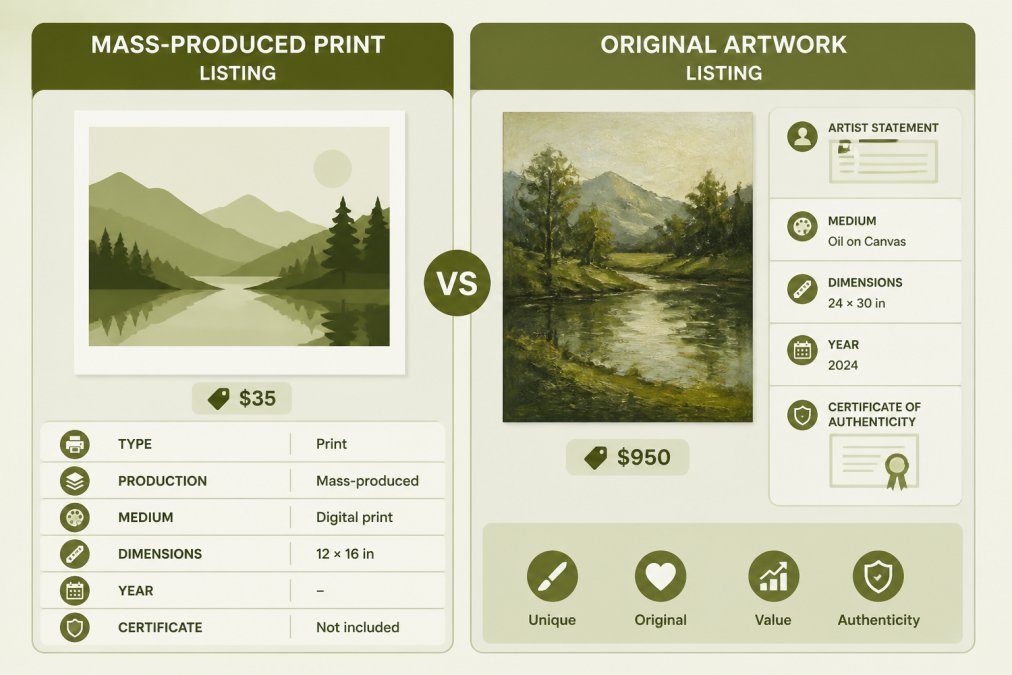
- Authenticity. Each piece is one of a kind, and a curated gallery should tell you who made it, when, and with what materials, not just show a photo.
- Direct impact. Your purchase supports a working creator; the share reaching the artist depends on the commission model, so ask.
- Cultural richness. Art from another region brings a perspective your home cannot hold, and online galleries are the only practical way to access it without travel.
- Long-term value. Work by an emerging artist can appreciate as their career grows, though this is never guaranteed and should not be your primary reason to buy.
Is Buying Art Online Safe? A Guide to Trusting Digital Galleries
Buying art online is safe when the gallery verifies its artists, uses secure payment processing, and stands behind shipping and returns. The risk is not the internet but unvetted sources with no accountability, a curated gallery removes most of that risk before checkout.
- Artist verification. Does the gallery vet who it represents, or can anyone upload anything?
- Clear provenance. Can the listing tell you who made the piece, when, and with what materials?
- Secure checkout. Payment should run through an encrypted, established processor.
- Shipping and damage policy. A serious gallery explains what happens if a sculpture arrives cracked.
- Reachable support. A real human should answer questions before and after the sale.
Best Practices for Collecting Art Online
Good collecting habits protect both your money and the artist. This process takes minutes and prevents the most expensive first-time buyer mistakes.
- Research the gallery and the artist. Read the artist's online portfolio and any statement about their artistic practice before you commit.
- Verify authenticity and provenance. Ask where the piece came from, what materials were used, and whether a certificate of authenticity is included.
- Check shipping and return policies. Confirm how the work is packed, insured, and what happens if it is damaged in transit.
- Use secure payment methods. Pay through the gallery's encrypted checkout, never by wiring funds to a personal account.
- Inspect on arrival. Unbox carefully, photograph the packaging, and report any issue within the stated window.
How to Navigate Online Galleries and Digital Curation
Digital curation means selecting and presenting artwork online with the care a physical gallery applies to a hanging. A well-curated platform groups work by artist, theme, or region so you browse with intent instead of scrolling an endless feed, and curation is a filter you can evaluate.
- Look at what is excluded. A curated gallery rejects work. If every submission is accepted, you are browsing a marketplace, not a gallery.
- Check for coherent bodies of work. A curated platform shows several pieces by the same artist, not one-offs, so you can judge whether a piece is representative.
- Read the curatorial statement. A gallery that explains why it selected a group of artists is doing editorial work; one that cannot is hosting.
- Filter by medium first. Narrow to paintings, prints, or sculpture so you compare like with like on price and scale.
- Use virtual exhibitions. Curated online shows let you view a themed collection as you would walk a gallery, a better way to judge an artist's range than a single listing.
Evaluating Image Quality and Listing Accuracy
The technical side is where most buyers get burned. Small, blurry photos are a warning sign, but so is a listing that looks perfect and tells you nothing. Check these specifics before you commit:
- Resolution and scale. A serious gallery provides high-resolution images and a clear sense of scale, ideally the work on a wall or beside a common object.
- Color reference. Ask for a photo under natural light or a short video; screens calibrate differently, and a 30-second clip reveals texture and true color better than any listing photo.
- Dimensions in both units. Look for inches and centimeters, plus a clear statement of medium (oil on linen, archival pigment print, bronze).
- Edition information. For prints, confirm open versus limited edition and the edition size, this affects value and price.
- Condition disclosure. Existing wear, prior restoration, or framing damage should be stated up front, not discovered on arrival.
Verifying Authenticity and Provenance
Authenticity is the question online galleries must answer better than physical ones, since you cannot inspect the object in person. A certificate of authenticity signed by the artist is the baseline. Beyond that, ask:
- Where did the piece come from, made for sale, or resale?
- Has it been exhibited or published anywhere?
- Is there a documented chain of ownership if it is a resale?
Buying Safely: Payment, Shipping, and Disputes
Safety online is not about the internet; it is about the specific platform's practices. The Federal Trade Commission's guidance on online shopping is a useful baseline for what protections you are entitled to as a buyer, including the right to accurate descriptions and fair dispute handling. In practice, that means:
- Pay through the gallery's encrypted checkout. Never wire funds to a personal account, and never pay through a peer-to-peer app that offers no buyer protection.
- Confirm shipping, insurance, and packing method. Ask how the work is packed, whether it is insured in transit, and who pays if it arrives damaged.
- Know the return window. A serious gallery publishes a clear return and damage policy, and honors it.
- Inspect on arrival. Unbox carefully, photograph the packaging before you open it, and report any issue within the stated window.
Budget-Friendly and Cross-Platform Ways to Support Artists
You do not need a large budget to make a difference. Supporting local artists through online galleries works at almost any price point, and some of the most effective support costs nothing.
Start with what you can afford:
-
Buy prints instead of originals. High-quality prints from the same artist carry the work into your home at a fraction of the cost.
-
Set a small monthly art budget. Even a modest recurring amount builds a collection over a year.
-
Buy one piece well. A single thoughtful purchase beats five impulse buys.
-
Gift original work. A one-of-a-kind piece is a more meaningful gift than another mass-produced item.
-
Share their work on social media. A genuine post about a piece you love reaches people the artist cannot.
-
Attend virtual exhibitions and artist talks. Attendance signals demand and often leads to future opportunities for the maker.
-
Leave a review. Reviews help emerging artists build the visibility that leads to sales.
-
Sign up for their newsletter. A direct audience is more durable than any algorithm.
Conclusion
The hardest part of collecting is not the budget; it is trusting a platform enough to click buy. When a gallery verifies its artists, documents each piece, and stands behind its shipping, that trust is earned, not assumed.
Frequently Asked Questions
Is buying art online safe for new collectors?
Buying art online is safe when you use reputable galleries that verify artists, offer secure payment processing, and provide clear return policies. Look for platforms with transparent artist profiles, high-resolution images, and customer reviews. Aartzy, for example, provides secure payment processing and free worldwide shipping, so you can purchase with confidence. Start with a smaller piece to test the process before investing in higher-priced original artwork.
How do online galleries ensure artists are paid fairly?
Galleries typically set commission rates and payment schedules that are disclosed to artists upfront. Some platforms, like Aartzy, charge no upfront fees to artists and only take a percentage when a sale is made. When supporting local artists through online galleries, look for clear information about how much of your purchase reaches the creator. If the gallery does not explain its payout model, ask before you buy.
What are the benefits of buying original art online?
Buying original art online gives you access to a global selection of unique pieces that you will not find in mass-produced decor. You can discover emerging artists and support the creative economy. Original artwork also tends to hold or increase in value over time, making it a meaningful purchase that enriches your space and the artist's career.
How can I support local artists on a budget?
You do not need a large budget to make a difference. Many online galleries offer affordable prints, small works, and sculptures at various price points. You can also share artists' work on social media, attend virtual exhibitions, and sign up for newsletters to stay engaged. Even a single purchase helps sustain an artist's practice. Prioritize pieces you genuinely love, and remember that consistent support, not just big spending, builds lasting careers.